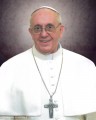
Pray for Pope Francis
Scroll down for topics
 100+ Important Documents in United States History
Apostolic Fathers of the Church
Biographies & Writings of Notable Catholics
Catholic News Commentary by Michael Voris, S.T.B.

(Death, Heaven, Purgatory, Hell)
Links to Churches and Religions
Links to Newspapers, Radio and Television
Links to specialized Catholic News services
General Instruction of the Roman Missal
****
****
****
****
Rite of Christian Initiation for Adults

Visits to this site
Is Islam a religion of peace?
James A. Beverley
Osama bin Laden,
the world's most notorious terrorist, has handed Muslims everywhere their worst
public-relations nightmare: September 11 as a picture, an embodiment, of Islam.
Muslims now have to define themselves in relation to the day of infamy.
Abdulaziz Sachedina, a Muslim scholar at the University of Virginia, says he
does not remember ever praying so earnestly that God would spare Muslims the
blame for "such madness that was unleashed upon New York and Washington . …I
felt the pain and, perhaps for the first time in my entire life, I felt
embarrassed at the thought that it could very well be my fellow Muslims who had
committed this horrendous act of terrorism. How could these terrorists invoke
God's mercifulness and compassion when they had, through their evil act, put to
shame the entire history of this great religion and its culture of toleration?"
Every judgment about Islam, all reaction to Muslim doctrine, and each
Muslim-Christian encounter are now cast in light of the events of that dreadful
day.
Islam as a Path of Peace
There are three distinct interpretations of the events of September 11. The
first view is that the terrorist acts do not represent Islam. President George
W. Bush best expressed this notion when he said that "Islam is a religion of
peace." One of the leading Muslims to echo this is Yusuf Islam (the former rock
musician Cat Stevens, who now helps promote Muslim education in England).
"Today, I am aghast at the horror of recent events and feel it a duty to speak
out," he said in a London newspaper. "Not only did terrorists hijack planes and
destroy life; they also hijacked the beautiful religion of Islam."
During an interfaith ceremony at Yankee Stadium on September 23, Imam Izak-El M.
Pasha pleaded, "Do not allow the ignorance of people to have you attack your
good neighbors. We are Muslims, but we are Americans. We Muslims, Americans,
stand today with a heavy weight on our shoulders that those who would dare do
such dastardly acts claim our faith. They are no believers in God at all."
Major Muslim organizations throughout North America, including the Council on
American-Islamic Relations, the Islamic Society of North America, and the Muslim
Students Association, denounced the work of the terrorists. The powerful
American Muslim Council issued a press release on September 11, saying it
"strongly condemns this morning's plane attacks on the World Trade Center and
the Pentagon and expresses deep sorrow for Americans that were injured and
killed. amc sends out its condolences to all the families of the victims of this
cowardly terrorist attack."
With the exception of Iraq, Muslim nations distanced themselves from the attack
on America. "Iran has vehemently condemned the suicidal terrorist attacks in the
United States," Iran Today reported in a front-page story on September 24, "and
has expressed its deep sorrow and sympathy with the American nation." The
governments of Bahrain, Egypt, Lebanon, Oman, Pakistan, Palestine, Qatar, Saudi
Arabia, Turkey, United Arab Emirates, and Yemen expressed similar sentiments.
Leading intellectuals, who have argued that terrorist acts represent only fringe
Muslims, have also promoted the view that Islam is a religion of peace. Edward
Said, the controversial Columbia University professor, argued in The Nation that
September 11 is an act of cultic religion. Comparing Islamists to the Branch
Davidians and the Rev. Jim Jones, he said September 11 is a model of "the
carefully planned and horrendous, pathologically motivated suicide attack and
mass slaughter by a small group of deranged militants . …the capture of big
ideas by a tiny band of crazed fanatics for criminal purposes."
Mark Juergensmeyer, professor at the University of California at Santa Barbara
and a specialist on religious violence, put it similarly: "Osama bin Laden is to
Islam [what] Timothy McVeigh is to Christianity."
The Darker Side
After initial emphasis on Islam as a religion of peace, a second interpretation
came to the fore. Editorials started to emerge that were less optimistic about
Islam per se and far more alarmed about the scope and depth of militant Islam.
Novelist Salman Rushdie, on whom the late Ayatollah Khomeini once issued a death
order, wrote in The New York Times:
If this isn't about Islam, why the worldwide Muslim demonstrations in support of
Osama bin Laden and Al Qaeda? Why did those 10,000 men armed with swords and
axes mass on the Pakistan-Afghanistan frontier, answering some mullah's call to
jihad? Why are the war's first British casualties three Muslim men who died
fighting on the Taliban side? . …[Islamists have] a loathing of modern society
in general, riddled as it is with music, godlessness, and sex; and a more
particularized loathing (and fear) of the prospect that their own immediate
surroundings could be taken over—"Westoxicated"—by the liberal Western-style way
of life.
Poverty is their great helper, and the fruit of their efforts is paranoia. This
paranoid Islam, which blames outsiders, "infidels," for all the ills of Muslim
societies, and whose proposed remedy is the closing of those societies to the
rival project of modernity, is presently the fastest growing version of Islam in
the world.
Others have been naming Islam's dark side as well, without suggesting that all
Muslims are terrorists. Thomas Friedman, author of From Beirut to Jerusalem, has
taunted Osama bin Laden in his New York Times columns, while also warning of the
terrorist's popularity in Saudi Arabia, Pakistan, and other Muslim nations.
British journalist Julie Burchill wrote a scathing article in The Guardian
against the "sustained effort on the part of the British media to present
Islam—even after the Rushdie affair and now during the Taliban's reign of
terror—as something essentially 'joyous' and 'vibrant,' sort of like
Afro-Caribbean culture, only with fasting and fatwas."
Melanie Phillips, writing in The Times of London, raises the possibility of
treason among British Muslims. "As if the progress of the Afghan war wasn't
enough to worry about, a nightmare specter is emerging at home. The attitude of
many British Muslims should cause the greatest possible alarm that we have a
fifth column in our midst . …Thousands of alienated young Muslims, most of them
born and bred here but who regard themselves as an army within, are waiting for
an opportunity to help to destroy the society that sustains them. We now stare
into the abyss, aghast."
In the weeks after the World Trade Center crumbled, there was no proof of an
Islamic world totally united against terrorism. Rick Bragg reported in The New
York Times about Muslim boys running through their school compounds in Pakistan
on September 11. They were "celebrating, stabbing the fingers on one hand into
the palm of the other, to simulate a plane stabbing into a building."
Palestinian authorities went into overdrive to suppress images of youths
celebrating the deaths in America.
Interpreting Jihad
Every discussion of Islamic militancy turns eventually to two fundamental
concerns. First, how much is Islamism (that practiced by fundamentalist Muslims
open to violence) rooted in the teaching and practice of the prophet Muhammad?
Would he celebrate the work of Osama bin Laden? Second, are the violent jihads
of our day sanctioned by the Qur'an and by the actions of early Muslim leaders?
The prophet himself engaged in many military battles and could be merciless to
his enemies, even those who simply attacked him verbally. His original
sympathies with Jews and Christians as "Peoples of the Book" gave way to a
harsher treatment when they did not follow Islam. In one infamous episode,
Muhammad cut the heads off hundreds of Jewish males of the Beni Quraiza tribe
who did not side with him in battle. The prophet is quoted as saying, "The sword
is the key of heaven and hell; a drop of blood shed in the cause of Allah, a
night spent in arms, is of more avail than two months of fasting or prayer:
whosoever falls in battle, his sins are forgiven, and at the day of judgment his
limbs shall be supplied by the wings of angels and cherubim."
In reference to the Qur'an, many have drawn attention to the famous passage in
Surah 2:256: "Let there be no compulsion in religion." This verse fits well with
other Qur'an verses in which jihad means personal and communal spiritual
struggle or striving. But the Qur'an also uses jihad to mean "holy war," and the
language can be extreme. Surah 5:33 reads, "The punishment of those who wage war
against God and His Messenger, and strive with might and main for mischief
through the land is: execution, or crucifixion, or cutting off of hands and feet
from opposite sides, or exile from the land: that is their disgrace in this
world, and a heavy punishment is theirs in the Hereafter."
Both the example of the prophet and some emphases in the Qur'an provided warrant
for Islam's earliest leaders to spread Islam by military conquest. Bloody
expansionism was also justified through original Islamic law that divided the
world into two realms: Dar al-Harb (the land of war) and Dar al-Islam (land
under Islamic rule). Both Paul Fregosi's Jihad in the West and Jewish scholar
Bat Ye'or's Decline of Eastern Christianity Under Islam document the reality of
Muslim crusades long before the notorious Christian crusades of the Middle Ages.
Out of the vortex of these realities emerge two different perspectives among
modern Muslims. Islamists consider their actions a true jihad or "holy war"
against infidels and the enemies of Islam. They believe it is right to target
America, "the great Satan." Osama bin Laden believes that the Qur'an supports
his campaign, that the prophet would bless his cause, and that Allah is on his
side. But the vast majority of Muslims believe that nothing in Muhammad's life
or in the Qur'an or Islamic law justifies terrorism.
Bernard Lewis, the great historian of Islam, noted in The Wall Street Journal
that throughout history, Muslims have given jihad both spiritual and military
meaning. Lewis also pays particular attention to the legal traditions in Islam
about what constitutes just war. After noting the many limitations placed on
military jihad, he writes, "What the classical jurists of Islam never remotely
considered is the kind of unprovoked, unannounced mass slaughter of uninvolved
civil populations that we saw in New York. For this there is no precedent and no
authority in Islam."
"The Clash of Civilizations," Samuel Huntington's essay for Foreign Affairs
(Summer 1993), has attracted considerable attention in recent months. Writing
just after the Gulf War, Huntington analyzed the competing ideologies of our
time and drew particular attention to the clash between Islam and the West. His
concern has obvious merit, although critics have made a crucial point that Islam
is no monolith. There are clashes within Islamic civilization itself.
What may emerge as the most significant factor in the current shape of our
world, then, is not the clash between Islam and the West. It is, instead, the
clash between Muslims as they try to define their faith for the 21st century.
Islam clearly does not speak with one voice. It shows nearly as much diversity
as does Christianity (see "A Many Splintered Thing"). The debate within Islam
will be protracted, regardless of how long military campaigns continue against
any Islamist movement.
Copyright © 2003-2005, Dads.org. All rights reserved