Pray for Pope Francis
Scroll down for topics
 100+ Important Documents in United States History
Apostolic Fathers of the Church
Biographies & Writings of Notable Catholics
Catholic News Commentary by Michael Voris, S.T.B.

(Death, Heaven, Purgatory, Hell)
Links to Churches and Religions
Links to Newspapers, Radio and Television
Links to specialized Catholic News services
General Instruction of the Roman Missal
****
****
****
****
Rite of Christian Initiation for Adults

Visits to this site
Sin Is In The Blood
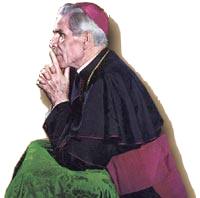
Archbishop Fulton Sheen
We
are living in about the only period in the
world’s history that there is a universal denial
of guilt. This was foretold by Dostoevsky who
wrote; “The time is coming where men will say
that there is no sin, there is no guilt, only
hunger. And they will come crying and fonning to
our feet saying, “Give us bread.”
It used to be that we Catholics were the only
ones who believed in the Immaculate Conception.
Now everybody believes that he is immaculately
conceived. We have even had in the Church in the
last few years, the idea that children should
not be taught about sin and that Confession
would not be required before Communion because
it would give the a wrong sense of guilt. Now
every child, despite the insufficient statistics
of “pi age”, every single child three years of
age and upwards understands a broken
relationship, which is the essence of sin. Just
let a mother tell a child of that age, “Mommy no
longer loves you”, and you see the disturbance
caused by a broken relationship.
And so general has this denial of sin been, that
it has not been theologians who have resurrected
the idea, it is the psychiatrist. Karl Menninger
of the Menninger Psychiatric Institute of Kansas
has just published a book entitled “What Has
Happened To Sin?” He shows how there has been a
slow devolution of the concept. He said that
moralists stopped preaching about sin because
everything was love. And then the jurists picked
it up and sin, under law, became a crime. Then
the psychiatrist took it up from the legalist
and sin then became a symptom or a complex.
There have been some rather tragic effects of
this denial of sin. First of all we have many
complexes that are produced by sin without ever
tracing the true cause, which is guilt. Take for
example Shakespeare’s Macbeth. Shakespeare was
born in 1554 as I recall, and died in 1616, long
before there was any such thing as psychiatry;
and yet in this tragedy Macbeth has a psychosis
and Lady Macbeth has a neurosis. Both of them
contrived to murder the King in order to seize
the throne. Macbeth thinks that he sees the
dagger before him, the instrument of murder,
with the handle toward his hand.
Lady Macbeth had the neurosis; she thought that
she saw blood on her hands, spots. At last, all
the water of the seven seas were not enough to
wash that blood from her hands. There was no
blood, there was no dagger but these were the
psychological manifestations of guilt. Because
there is an abnormal show of guilt, it does not
prove that there is no normal guilt at the basis
and foundation.
A woman once came to see me about her brother.
She said he had been under psychiatric help for
three years and had wasted away to about a
hundred pounds. I said, “I can not do anything
with him if his problem is in the realm of
psychiatry, but if it is moral I can help him.”
He looked almost like a ghost he was so thin. I
said, “Talk to me for about forty five minutes,
I will not interrupt you.” At the end of
forty-five minutes I said to him, “How much did
you steal?” He said, “I didn’t steal anything.”
I said, “How much did you steal?” He said, “I
didn’t tell you I stole!” “How much was it?” He
said, “Three thousand dollars. How did you know
I stole?” I said, “I didn’t know you stole but
one of the things you told me was that whenever
you put money in the collection box you always
wiped it off first so I thought maybe you were
involved with dirty money.”
And so beneath these two or three years of
psychiatric treatment was a real guilt, which
was thievery. So we have become today, patients
instead of penitents and then we have
rationalized guilt. It hardly pays anymore to
ask anyone, “Why did you do this? Why did you do
that”, because the rationalization would be
almost as stupid as that of Aaron. Remember the
story of David? David was out on his sundeck one
day and he saw in the opposite apartment,
Bathsheba. He invited her over to see his
etchings, loved her not wisely but too well and
she was found with child. The husband is at war,
David sends for him, tells Uriah to go home to
his wife so he could blame paternity unto the
husband. He said, “I can’t go home to my wife,
we are at war.” David got him drunk and still he
did not go home; he slept in David’s front yard.
Then David sent Uriah back to battle and he said
to the general, “Some are killed in battle,
maybe Uriah will be killed.” Uriah was and David
had no sense whatever of guilt until the day
that Nathan came with a social problem. He said
there was a poor man who had one ewe lamb and a
rich neighbor killed that ewe lamb to serve his
friends. David said, “That man shall restore
fourfold and shall pay with his life.” Nathan
said, “Thou art the man! You stole a ewe lamb of
Uriah.” Then he wrote “Sol Miserere Mei” and the
guilt came out.
Here incidentally is a warning to us about
social justice; social justice is one of the
most difficult of all issues to practice, the
easiest to talk about because sometimes social
justice is just a cover-up for individual
justice, as it was in the case of David; and
thus sin and guilt are denied. Now, as
ambassadors of the Lord we have to deal with
this subject of guilt. We have now to rediscover
it in souls; and our problem is so related to
reconciling sinners to God. Our problem is, how
is sin forgiven? What is the ultimate basis of
the remission of sin? This is a question that we
have to answer if we are to understand our
priesthood. The answer is given in the 22nd
verse of chapter nine of the Epistle to the
Hebrews. “Without the shedding of blood there is
no forgiveness of sin.”
. “Without the shedding of blood there is no
forgiveness of sin.” This is an absolute. Why is
that necessary? Well, because sin is in the
blood! It is in the blood of the degenerate, in
the blood of the alcoholic, in the blood of the
addict; sin is in the blood of the diseased and
is running through every gateway and alley of
the body. And it would almost seem therefore if
we were ever to expunge sin, we would have to
get rid of blood. That might be one reason.
Another reason we read in the Book of Leviticus;
“The life of man is in the blood”, therefore the
higher the life, the more precious the blood.
When therefore you come to the Life of Christ
Who sheds His blood you get the total remission
of sin. Without the shedding of blood there is
no remission of sin.
When Caleb and Joshua went in to Jericho they
met the prostitute Rahab, who asked to be saved
because she believed in the God of Israel. Caleb
and Joshua told her to let a scarlet cord down
from the window and when they crossed the Jordan
they would save her and her family. Now, let's
study that scarlet cord of blood. As it runs
through the Scriptures, for blood is mentioned
over four hundred seventy times in Scripture.
First Adam and Eve; they found themselves naked
and were ashamed. Shame is exposure so they made
an apron of fig leaves and the fig leaves dried
and they were ashamed.
Incidentally, the fig leaf that was once put
over the secret parts of man and woman in
Genesis, in Greek sculptures, are today put over
the face. The person does not matter; in our
eroticism it is only the pleasure; you drink the
water, you forget the glass. How was the shame
of Adam and Eve covered? You have to know your
Scripture well to answer that question. Just one
single line in Genesis, either chapter two or
three, how was the shame covered? God made for
them, clothing from the skins of animals. Notice
three things,
1. God did something
2. It involved the shedding of blood because you
never get a skin unless there had been a
shedding of blood.
3. Adam and Eve were not killed; it was an
animal that was killed.
So, God does something, it involves the shedding
of blood and it is done vicariously; a
substitute is used.
Following the scarlet cord we come to Cain and
Abel. Cain is fearful after he has killed his
brother Abel, that he himself might be killed.
God said He would put a mark; a brand upon Cain
and no one would kill him. Why this quarrel
between the two? Because of the nature of
sacrifices. Cain offered technological
sacrifice, he offered the produce of the earth;
the earth was cursed for one thing and the
fruits of the earth cost him nothing. Abel
remembered the tradition, the clothing of his
father and mother; for the tradition of blood
had already crept into the human race and he
offered a blood sacrifice, the firstlings of his
flock. Cain’s sacrifice was not accepted, hence
the murder. What was the brand that God put upon
the forehead of Cain? It was probably the blood
of his brother Abel. For we are saved only by
blood.
In comes Abraham, called out of the land of Ur
not knowing where he is going. What a man of
faith; he is praised eleven times for his faith
in the Epistle of the Hebrews. And Abraham, when
he is eighty and Sarah is seventy, has no heir.
And God had told Abraham when He called him;
“Your progeny will be as numerous as the stars
of the Heaven and the sands of the sea.” And at
eighty, no son. Where is the promise of God?
Sarah suggested that he consort with the
Egyptian maid, Agar, from which came Ishmael,
“The “wild ass” of the desert”, says Scriptures,
“from whom will come many nations and many
kings.” But that was not the heir that was
promised, it was to be through Sarah.
When Abraham is almost a hundred and his wife is
almost ninety, when they both, according to the
New Testament had dried up and passed the age of
bearing, God said to them, “Now you will have a
son.” Sarah laughed. God said, “You laughed!”
Sarah said, “I did not laugh.” So the child was
called “Laughter”, which is the meaning of
Isaac. Now after all this waiting, Abraham and
Sarah are rejuvenated. When he is a grown man,
God says to Abraham “testing him”, says
Scripture, “ Take your son to the Mount and
offer him in sacrifice.” Imagine, the only son
in whom there was to be this tremendous progeny.
And Abraham puts wood on the back of his son,
Isaac. And for three days for all intents and
purposes Isaac is dead. Up the mountain he goes
and finally they are at the top of the mountain,
Isaac says to his father, Abraham, “Where is the
lamb?” And those words were caught up in the
breeze of Mount Mariah and wafted through the
centuries. “Where is the lamb? Where is the
lamb?” Abraham said, “God will provide.” And as
he raised the knife to kill his son in
obedience, it is stayed by the angel and a ram
is found near by in the bushes and that is
offered in sacrifice. God did something; it
involved the shedding of blood and it was
vicarious, a ram was offered rather than Isaac;
a perfect picture of a father offering his son.
Then Moses is called. And when Moses is called
out of Egypt, forty years he had been a servant
of Pharaoh. Forty years he was in the desert and
only when he is eighty he is called to be the
leader of the Israelites, to take them into the
desert and then into the Promised Land. He had
already killed a man and that was the reason he
had to go into the desert. Now at eighty he goes
to Pharaoh and after many wonders and miracles,
Pharaoh promises and then negates his promise.
Moses pleads, “Let my people go!” And finally
the patience of God is at and end and God said
to Moses, “This very night and angel will
destroy the first born of man and beast in all
Egypt. You kill a lamb, one year old, unspotted,
no bones broken and take the blood of that lamb
and sprinkle it over the doorposts. Not on the
floor, blood is sacred. And when that destroying
angel sees the blood on the door of your house,
the angel will pass over that house.” The
Israelites were saved and all the first born of
man and beast of the Egyptians were slain. God
did something! It involved the shedding of
blood; it was vicarious. The Israelites were not
killed; it was the lamb that was killed. And as
they wander through the desert, a journey
incidentally, which would have only taken three
weeks, takes them forty years because of
disobediences.
On one occasion, the Israelites because of their
disobedience had been bitten by poisonous
serpents; Moses interceded and God said, “Make a
serpent of brass that looks like the serpent
that stung the people. Hang that brass serpent
up on the crotch of a tree and everyone who
looks upon that serpent of brass will be healed
of the poisonous bite.” Now there is absolutely
nothing in looking at a brass serpent that will
cure snakebite. But, we are living in days of
symbolism. And when the good Lord came and was
talking to the night man, Nicodemus, for he only
appeared in Scripture at night, never in the
day; our Lord said to him, “As Moses lifted the
serpent in the desert so shall the Son of Man be
lifted up.” Our Lord is here implying; that
serpent of brass looked just exactly like the
serpent that stung the Israelites but there was
no poison in that brass serpent.
“And all who looked upon it in obedience to My
word were healed. So I shall be lifted up on the
crotch of a tree; I shall look as if I am full
of sin, for I am numbered among the
transgressors bearing the sins of the world. And
as there was no poison in that serpent, so there
is no sin in Me and all who look upon Me shall
be healed of the bite of the serpent, which is
Satan.”
That was the foretelling and symbol. And
another; the scapegoat. On the Day of Atonement,
every year the priest would bring before him,
two goats. One would be chosen by lot to be
killed. “Which of the two will you, that I
release under you?” (Christ or Barrabas) One
goat would be killed and the blood of that goat
would then be sprinkled upon the other goat but
only after the high priest had laid his hands in
a kind of “hanc igitur, over that goat; laid
upon that goat all the sins of Israel. Then
after the sprinkling of the blood the goat was
led…Scripture does not tell us but an old Jewish
tradition…was led by a Gentile, delivered over
to the Gentiles, taken over to a precipice fifty
or sixty miles away and thrown over the
precipice, all the sins of Israel were forgotten
and forgiven. God did something; it involved the
shedding of blood and it was done vicariously.
The same ceremony took place with the two birds.
One was killed and the blood sprinkled on the
other. Then there came and incident where there
was a shortage of water; two incidents, at
Raphidim and at Kadesh, about thirty-eight years
apart. At Raphidim, God said to Moses when there
was a shortage of water, “Strike the rock.” St.
Paul tells us in the Letter to the Corinthians
that the rock was Christ. And water came out.
Years later, once again a shortage of water and
God said to Moses, “Speak to the rock.” Moses
turned to the people and he said , “You stiff
necked people! Don’t you think I can draw water
from the rock?” And he struck it twice and water
came forth and God said, “For that, you do not
enter the Promised Land.” Three times Moses
begged, “Let me!” God said, “Ask me no more!”
Why? The rock is Christ; that rock is struck
once in death on Calvary, there is no other name
under Heaven by which we can be saved. The rock
is not struck twice.
The same kind of sin is committed by the two
sons of Aaron, Nadab and Abihu, when they lit
strange fires in the temple but we will not have
time to go into that. They were struck dead on
the day of their ordination. For all the incense
fires had to be lighted from the Altar of
Sacrifice; they skipped sacrifice, they skipped
the shedding of blood, redemption, and they went
right to intercession as if Heaven could be
opened without the shedding of blood.
Now we come to the first Passover of our Blessed
Lord’s public life. John the Baptist is
preaching along the Jordan and in that spot,
which was so close to Jericho and from which
there led that road all the way up from
Jerusalem, John the Baptist could see all the
pilgrims on their way up to the Temple
fulfilling the Law of the Atonement. Every
family had to sacrifice a lamb, one year old and
unspotted with no bone broken. Children had tied
purple and red scarlet ribbons about the neck of
the Paschal Lamb. If a family was poor, twenty
people could join together to offer the lamb.
And as John was preaching his hard message of
penance and laying the axe to the roof of the
tree, he sees all of these lambs.
Josephus tells us that ten or fifteen years
after the death of Christ that two hundred sixty
thousand lambs were offered in the Temple of
Jerusalem. The religion of Israel was a
veritable hemorrhage of blood. And as John
watches this procession of the Passover, there
is still in the air the question of Isaac. Where
is the lamb? Where is the lamb? Suddenly he
stops and looks out at someone in the crowd,
interrupts his discourse and says, “Look! Look,
the Lamb of God, who takes away the sins of the
world. Where is the Lamb? The Lamb had come and
then came the last of Passover and our Blessed
Lord is sentenced to His cross. It is a very
important day for the Jews, this Passover
because they had to offer this lamb and it was
the one day of the year the high priest could go
behind the veil.
This great temple, which was in the course of
construction, the third temple in the history of
the Israelites, was of course built upon the
model of the Tabernacle in the desert, which was
only about sixty feet long with badger skin on
the outside; quite unattractive and no light in
the Tabernacle except the candles, and that
Tabernacle, which as I say was the prelude to
this temple scene that we are about to describe.
As you came in, there was at the end, a laver;
the only piece of furniture in the temple for
which God did not give a measurement. Twenty-two
chapters there are in the Old Testament about
the Tabernacle and every single detail is
mentioned by God. Why our architects never read
it I cannot understand. We allow them to build
without going back to the planning of the Divine
architect. There was the laver; no measurements.
Why? Because not all of us need the same
washing; some need more than others.
In front of that the Altar of Sacrifice, with
the horns where the animal was tied. Over there,
the candlestick, the brass candlestick made from
the jewels of the Israelite women who took their
jewels out of Egypt and some of the Egyptian
jewels as well. Over here, the bread of
presence, the bread of perpetual presence before
which had to burn a light. Twelve loaves changed
every week for the twelve tribes of Israel.
Here, the Altar of Intercession, and here, the
great veil. Now in this Temple at the time of
our Blessed Lord, the veil was about sixty feet
high, made of crimson, scarlet, red purple, with
two great Seraphim wrought in gold because in
the Old Testament when God ordered the
tabernacle made, what would be our Tabernacle,
there had to be two Seraphim with their wings
touching. It should always be in our
architecture. St. Peter, in his Epistle says
that the Seraphim wonder at redemption; they
wonder what God did for us.
So this great veil was now sprinkled with blood
by the high priest; he alone could enter on this
day and commune with Divinity. And when he
sprinkled it gave him the right to go behind the
veil. The old Holy of Holies, the original one
contained the Rod of Aaron, a piece of the Manna
and the Tablets of the Law. At this particular
moment on Good Friday the priest is now about to
take the blood of the lamb and sprinkle that
great veil. On the hill of Calvary, other blood
was being sprinkled. And at the moment that a
lance was run into the side of our Blessed Lord,
this veil in the Temple was rent, rent not from
bottom to top, for a man could do that. But rent
from top to bottom and the Holy of Holies, which
the people were never allowed to see, but only
the High Priest on the Day of Atonement. And
this was merely the earthly counterpart of
something else that was opened on the Hill of
Calvary; a mystery beautifully described in the
Epistle to the Hebrews.
So now my friends, the blood of Jesus makes us
free to enter boldly into the Sanctuary by the
new living way, which He has opened for us;
through the curtain, the way of His Flesh. So
there were two curtains, the curtain in the
Temple of Jerusalem and the curtain of the Flesh
on Mt. Calvary. The holy of Holies was opened,
which was only a symbol, and revealed to human
eyes the Holy of Holies, the Heart of Christ was
opened on the hill of Calvary.
So the Blood of Christ makes us free to enter
the Sanctuary by the new living Way, which He
has opened through the curtain of His Flesh.
Heaven was opened by that act. Every time any
one of us priests raise our hands in absolution
in that confessional, the blood of Christ is
dropping from our fingers. That is how sins are
forgiven. When we give Communion we are doing
what Moses did, just in figure when he would
sprinkle the congregation with blood. We are
sprinkling the congregation; what a blessed
privilege it is of ours to hold the cup of this
Precious Blood.
When I receive the Precious Blood, I think of
Rahab, I think of David and I think of the
Blessed Mother and I think of the Blood of
Christ. For I know that it is only by the
shedding of blood that there is any remission of
sin. This then is the reality in which we deal.
So sin is real but sin is not the worse thing in
the world. The worse thing in the world is the
denial of sin. If I am blind and deny that there
is any such thing as light, shall I ever see? If
I am deaf and deny there is any such thing as
harmony, will I ever hear? If I deny that there
is any such thing as sin, how shall I ever be
forgiven? The denial of sin is the unforgivable
sin; for it makes redemption impossible.
So even our sins, when we bring them to the
Blood of Christ, sometimes have a good side; we
are washed in that Blood. And, we rejoice as
priests and thank the Lord; for if we had never
sinned, we never could call Jesus Savior.
Transcribed by "Denise Wood" and were used with permission.
From: http://www.semperficatholic.com/
