Pray for Pope Francis
Scroll down for topics
 100+ Important Documents in United States History
Apostolic Fathers of the Church
Biographies & Writings of Notable Catholics
Catholic News Commentary by Michael Voris, S.T.B.

(Death, Heaven, Purgatory, Hell)
Links to Churches and Religions
Links to Newspapers, Radio and Television
Links to specialized Catholic News services
General Instruction of the Roman Missal
****
****
****
****
Rite of Christian Initiation for Adults

Visits to this site
The Ten Commandments
GRACE MACKINNON
Dear Grace, My son and I were discussing the importance of the Ten Commandments and how they are to be used as a guide. He says they are part of the Old Testament and therefore we need not focus that much on them. His attitude towards them is that they are just a lot of "Do Nots." Can you help me explain why God gave us these commandments and why they are still important for us today?
|
|
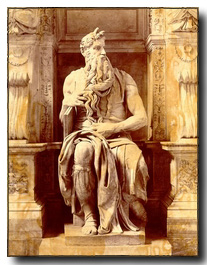
While it is certainly true that many people have this understanding or attitude
towards the Ten Commandments, it just so happens that the complete opposite is
true. The reality, you see, is that the reason God gave them to us was not to
limit or restrict us, but rather to set us free — free from sin. Who is it that
knows us better than the One who made us? Because we belong to God who loves us
so much, the only way we can be truly free and happy is when we live according
to His ways. That is when we become “who we really are” — sons and daughters of
the One, True, and Living God. It is precisely when we try to be “who we are
not” that we are not free.
Deep within every human heart, God inscribes what is known as the natural law, a
sort of code of moral conduct by which our reason tells us whether something is
in conformity with our true human nature (Romans 2:15). All of those things that
are not in agreement with our nature we are obviously to avoid because
ultimately they will not fulfill us. In other words, they will hinder and
possibly destroy the possibility of attaining our true destiny, heaven. This
should make sense. Would we feed our bodies gasoline when they are made to live
on food and water? This same basic principle applies to the moral order of our
lives, for we are a people who are a unity of body and soul. The Ten
Commandments are, if you will, a summary of this natural law, which reveals all
that is good for us. When the Hebrews, wandering in the desert, failed to obey
the natural law inscribed within them, God then gave to them the revealed law —
the Ten Commandments.
In his beautiful encyclical Veritatis Splendor (the Splendor of Truth)
the Holy Father John Paul II tells us that man’s freedom is not unlimited. Every
human person “is called to accept the moral law given by God. In fact, human
freedom finds its authentic and complete fulfillment precisely in the acceptance
of that law. God, who alone is good, knows perfectly what is good for man, and
by virtue of his very love proposes this good to man in the commandments. God's
law does not reduce, much less do away with human freedom; rather, it protects
and promotes that freedom” (n. 35).
Throughout the Scriptures, a certain theme is woven in, that in life, there are
two roads, the road to life and the road to death. By this we mean eternal life
and eternal death, for we know that this life here on earth is temporary. If you
can imagine this: On the road to life there are signposts, if you will, and
these signposts are the Ten Commandments. This connection between the
commandments and eternal life is clearly demonstrated by Jesus in the story of
the rich young man in Matthew’s Gospel. When asked, “Teacher, what must I do to
gain eternal life?” He answered him, “If you wish to enter into life, keep the
commandments” (Matthew 19: 16-17).
Yes, to many the commandments seem so challenging and restrictive, and this is
so because we live in a world where at every turn there is the temptation to
sin. But like Peter, who could do what seemed like the impossible when he walked
on water only by keeping his eyes fixed on Jesus (Matthew 15: 29-30), we too can
follow the Lord to our heavenly home. So, let us follow the “signs.” The road to
life is the right road to be on! You are indeed a good mother in wanting to
teach your children to love God.
ACKNOWLEDGEMENT
Grace MacKinnon. "The Ten Commandments." (March, 2004).
Reprinted with permission of Grace MacKinnon.
THE AUTHOR
Grace MacKinnon is a syndicated columnist and public speaker on Catholic doctrine. She is the author of Dear Grace: Answers to Questions About the Faith published by Our Sunday Visitor. Order online by e-mail at osvbooks@osv.com or call 1-800-348-2440.
Readers are welcome to submit questions about the Catholic faith to: Grace MacKinnon, 1234 Russell Drive #103, Brownsville, Texas 78520. Questions also may be sent by e-mail to: grace@deargrace.com.
You may visit Grace online at www.DearGrace.com.
Copyright © 2004 Grace D. MacKinnon
