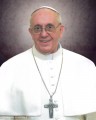
Pray for Pope Francis
Scroll down for topics
 100+ Important Documents in United States History
Apostolic Fathers of the Church
Biographies & Writings of Notable Catholics
Catholic News Commentary by Michael Voris, S.T.B.

(Death, Heaven, Purgatory, Hell)
Links to Churches and Religions
Links to Newspapers, Radio and Television
Links to specialized Catholic News services
General Instruction of the Roman Missal
****
****
****
****
Rite of Christian Initiation for Adults

Visits to this site
|
Hard work, know-how characterize new Bishop of Baker Robert Pfohman
Of the Sentinel 01/21/2000
LINCOLN, Neb.— “Good man, extremely hard-worker, capable administrator.” These are the words used by friends and colleagues to describe the new Bishop of the Diocese of Baker, Robert Francis Vasa.
This powerfully built 48-year-old priest-monsignor takes up his new duties next week as spiritual leader of 35,000 Catholics scattered around the far-flung Catholic community in Central and Eastern Oregon. He succeeds Bishop Thomas Connolly, who is retiring at age 77 after serving as Baker bishop for the past 28 years.
The 66,000-square-mile Baker Diocese encompasses two thirds of the State of Oregon. It is marked by ruggedly beautiful snow-peaked mountain ranges, semi-arid high-desert plateaus and Hells Canyon of the Snake River, at 7,800 feet from river to rim, the deepest gorge in North America.
The historic diocese also contains the City of Bend, the fastest-growing city in the Northwest, where the headquarters of the Baker Diocese was moved years ago because the city is more centrally located.
Oregon will represent more than just a change of scenery and geography for the new bishop, used to as he is to Nebraska’s rolling hills and conservative Catholic ethnic enclaves. Oregon is one of the most unchurched states in the country, with fully 65 percent of the population professing no religious beliefs at all. Oregon also has the dubious distinction of being the first legal entity in the world to sanction physician assisted suicide.
The new bishop is leaving the fertile farmlands of southern Nebraska, where he grew up and spent most of his life except for attendance at schools in Dallas, Denver and Rome. The area around here is normally covered with a blanket of snow by now, but so far has experienced a mild winter. Then the sturdy farmers of America’s Heartland will begin planting their corn, wheat, soybeans, alfalfa and sorghum crops, using up-to-date, no- and low-till farming practices so as to minimize wind-blown erosion of the precious topsoil. The dryland crops will grow exponentially during the stupefyingly hot and humid summer months to produce enormous harvests that feed people all over the world.
The new bishop arrives in Bend without really knowing a soul, beyond the few acquaintances he made during his brief visit here Nov. 19, the day Pope John Paul named him to succeed Bishop Connolly.
The low-key pastor–high school teacher–canon lawyer–
bishop takes on his new responsibilities with enthusiasm and humility, recognizing that it will take a big adjustment on his part to become the actual bishop of a flock. The largest group he has led so far is the 1.100-families who now make up the new $6 million St. Peter’s Parish and School in Lincoln, which he founded 10 years ago.
Until now, this affable Nebraska farm boy of proud Czech origin has served as vicar general and chief financial officer of the Lincoln Diocese, effectively the number-two man in the prosperous diocese, which is headed by Bishop Fabian Bruskewitz, an outgoing priest also of Czech origin, originally from the Archdiocese of Milwaukee, who served in the Vatican congregation for Catholic education for six years years before he was named bishop here.
Bishop Bruskewitz achieved some notoriety a few years ago when he told a group of reform-minded Catholics in his diocese either to abandon their demands for women priests or face excommunication. Parenthetically, Pope John Paul just last month reinforced this decision, telling German bishops that lay groups pushing for women priests in the church are acting against the will of Christ.
Besides being the diocesan headquarters, Lincoln also is the state capital of Nebraska, as well as home to the University of Nebraska Cornhuskers, frequent national collegiate football champions.
The 35,000 clean-cut university students add a special charm to this attractive, fast-growing community of 205,000 uncommonly wholesome Midwesterners, some of the friendliest, nicest people in the country. Catholics here account for about 13 percent of the population, which is accepting to all religions, unlike parts of unchurched Oregon. Lincoln became a household word for many Americans in the 1980s, after the $3.4 billion collapse of Charles Keating Jr.’s Lincoln Savings and Loan. The action set off a chain of savings-and-loan failures that resulted in the nation’s largest banking crisis since the Stock Market Crash in 1929.
Folks here are well aware of Bishop Vasa’s legendary capacity for hard work. He learned carpentry, plumbing and electrical skills from his late father, Joseph, who voluntarily performed all the maintenance work on the family parish church and school in rural Weston, a 35- minute drive from here. The Vasa family’s hilltop farms are located a few miles from the town, identifiable from a distance by their blue silos packed with corn for the family’s three dozen Angus dairy cows. Together, the homestead farm and another nearby are 280 acres. A third, bought a few years ago from a new widow across the road is 160 acres, but the fence line extends for a mile from the unpaved country road.
The steeple atop the 90-year-old St. John Nepomucene Catholic Church in tiny Weston, population less than 300, boasts that this is a bastion of Czech Catholicism. The three-block-long main street contains a post office, bank, American Legion post and general store. Temperatures in January and February here can reach 40 degrees below zero, made worse by a wind chill generated by steady 40-mile-an-hour winds. A mistake in weather like this can be fatal.
Bishop Vasa’s handyman skills, coupled with the daily requirement of milking a herd of dairy cows at 5:30 a.m. and again at 5 p.m. every day of the week, every week of the year, have instilled in him a work ethic that inspires awe even among other hard-working Nebraska farm-boys and –girls.
Explains the new bishop, wearing a trademark black Michelin baseball cap with white paint stains: “I’m not smart enough to be afraid of tackling anything.”
He learned all his construction skills from his dad, a legendary figure hereabouts who touched a lot of people’s lives in Saunders County, where the Vasa farms are located. “He was well read and interested in a lot of things, from architecture to philosophy to theology and photography,” Bishop Vasa said of his father, who died in 1998 at age 76. The father taught himself woodworking and taught the children engine overhauls and welding.
The family operated a small sawmill and cut its own boards for construction projects. The father also taught himself how to play the piano and played the organ in St. John Church. He installed the first phone system in the county, stringing a line a half mile to a neighboring farm.
“He was always doing something,” Bishop Vasa recalled.
The father is buried in a small Czech cemetery in full view of the family homestead a mile away on the next hill across fallow fields and unpaved country roads.
Bishop Vasa is always on the lookout for a project. For example, he decided by himself to display the diocese’s historic memorabilia in an unused room downstairs in the 20-year old chancery, set among impressive two story brick homes in the well-to-do south-central part of the city. Working alone at night, often late into the morning, he tore up the tile floor, subbed out removal of the asbestos-insulated heating ducts, rewired the electrical grid, installed a dropped ceiling with recessed lighting, laid new carpet, purchased used display cabinets from the local historical society and hauled them to the basement, where he reassembled them. Now the diocesan museum–archives are a must-see stop on any tour of the chancery.
Harry Knight, a retired plumbing and heating specialist who owned his own business in Lincoln for 40 years, works at the chancery. He came to know Bishop Vasa when he began working at the chancery. “We worked on many jobs together,” Knight said, “all sorts of jobs — handy-man jobs.”
As he approached 70 years of age, Knight, assisted by Vasa, was able to tackle a new challenge — computers. “I entered pledges for our annual Charity and Stewardship Appeal with the software that Bishop Vasa programmed himself,” Knight said.
Bishop Vasa “will tackle and do almost anything — of a religious or mechanical nature, you name it,” Knight said.
Both Martha and Doug Vandervort have known Bishop Vasa since he was first ordained in 1976. His first assignment was as assistant pastor at the Cathedral of the Risen Christ, where they have been members all their married life.
Doug is an acolyte at the Cathedral and Martha is a secretary at the chancery. “He is as comfortable with a screwdriver in his hand as he is with a pen,” Doug said. “He has good insights into people’s needs,” Martha said.
“He just is a solid individual. When he takes something on, he gets it done and when he says something, he stands by his convictions,” Doug said.
Bishop Vasa takes on these projects by himself because his family has always operated its farms on a shoestring budget. If a piece of equipment breaks down, family members must have the tools and know-how to get it working again, by themselves. The weather in Nebraska is notoriously unpredictable; planting season is a time for all hands to bear down with the task at hand.
Folks hereabout don’t waste much energy talking about esoterica. It’s not that they are backward or unsophisticated. Rather, they are concerned with more pressing, immediate concerns, such as whether they will be able to make enough money on their cattle sales and grain harvests next year to pay the principal and interest on their bank loans.
Bishop Vasa’s departure from here is leaving a big hole in the operation. Bishop Bruskewitz has had to reassign about four priests here to take up Bishop Vasa’s workload, and even that ambitious reorganization fails to cover all the work he did. He has performed just about every job a clergyman is asked to do in any diocese, including many they are not even trained for.
Msgr. Timothy Thorburn, the new vicar general, reports that he is still receiving calls from people in various organizations asking if he is taking over the new bishop’s duties as moderator of their small group. If so, does he plan to celebrate Mass for them at the regular time next week, at 5:40 a.m., say, in Valparaiso, 30 miles west of Lincoln? The fact is, the new bishop is pastor-spiritual director for a wide range of small groups, many of which he helped form, a specialty of his. He routinely celebrates Mass at 5:40 a.m. every Monday for eight or so Catholic physicians, after which they talk about medical ethics. Out of this association grew Holy Family Medical Specialties, part of the Catholic St. Elizabeth Hospital in Lincoln. The four-doctor practice specializes in Catholic medicine.
Bishop Vasa performs similar duty for other groups on other weekday mornings, including a men’s prayer group on Wednesday mornings. He sleeps in on Thursdays, when his first appointment is at 6:15 a.m.
He has worked 85 to 90 hours a week as a priest since he can remember, except he doesn’t call it work: he loves what he does, he says.
Every couple of months, he will head off to a cabin by himself to reflect on the great issues, returning rested to resume his pace after a day and a half alone.
He has the ability to take little naps when the occasion arises.
Bishop Vasa is anxious for the Installation and Ordination Mass and attendant ceremonies to be over with in Bend, so he can get on with the job. He has left decision-making on the liturgies and receptions to Father Thomas Faucher, vicar general in Bend, saying, “It’s better off I don’t help. I’m better at a shovel and pitchfork and farm equipment.”
He is uncomfortable with his new celebrity status. He plans at first to drive around the Baker Diocese to meet everyone, listening to their concerns and their expectations of him.
He is already impressed with the warm welcome he received in Bend, noting that he felt immediately welcomed and instantly at home.
One of the activities he hopes to resume is jogging; he ran eight to 10 miles a day for two years while in Rome studying canon law and even ran a marathon in Germany. Fr. Kenneth Borowiak contributed to this report.
|
