Pray for Pope Francis
Scroll down for topics
 100+ Important Documents in United States History
Apostolic Fathers of the Church
Biographies & Writings of Notable Catholics
Catholic News Commentary by Michael Voris, S.T.B.

(Death, Heaven, Purgatory, Hell)
Links to Churches and Religions
Links to Newspapers, Radio and Television
Links to specialized Catholic News services
General Instruction of the Roman Missal
****
****
****
****
Rite of Christian Initiation for Adults

Visits to this site
Will Europe destroy itself?
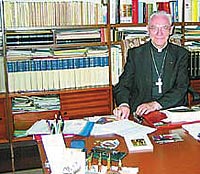
Wlodzimierz Redzioch with Cardinal Paul Poupard, the Vatican 'minister of culture'.
|
|
|
|
|
FIFTY YEARS IN THE
SERVICE TO THE CHURCH AND THE POPE |
Wlodzimierz Redzioch: - Nietzsche, Marks and Freud predicted that the 20th century would be an age of 'the death of God'. Andre Malraux claimed that 'the twenty-first century will be spiritual or it will not be at all'. Chesterton thought that man who stopped believing in God would believe in everything. Which of them was right?
CARDINAL PAUL POUPARD: - Recently I presided over the 5th meeting entitled
'Poetry of faith in the age of the death of God', for which I invited, as usual,
writers, poets, literary critics, believers and non-believers. This year the
theme of the meetings was the Spanish literature whereas last year we discussed
Eastern Europe: Norwid, Dostoyevsky, Soloviov. These discussions are the best
testimony that the era, which was to be 'an age of the death of God', in fact,
was the richest period in theological and christological works in the West.
Paul Riceur called Nietzsche, Marks and Freud 'maitres de soup on' - the masters
of suspicion. Today we look at 'the masters of suspicion' with scepticism. This
is an unexpected result of May of 1968 in France, which meant the end of the
domination of Marxism in the Western culture.
As far as Malraux is concerned, I remember his interview when he was asked about
these famous words. He said: 'I am too intelligent to proclaim such silly
prophecies. I might have said once that I did not preclude that at the beginning
of the new age there would be some new religious phenomenon'. It may be that
Malraux thought about a new religious awakening, I would say, a new paganism of
the type of the New Age.
- A propos paganism. In the West we see the spread of a new polytheism. The French anthropologist Marc Auge, in his book 'Le gnie du paganisme', expresses his sympathy for polytheism, which is to be an expression of opening. The American psychoanalyst James Hillman demands to appreciate 'pagan wisdom'. Michel Houellebecq strongly criticises Islam and other monotheistic religions, which are to be expressions of intolerance. Why do so many Western intellectuals fight against Christianity and even try to negate Christian roots of our civilisation?
- The Pontifical Council, which I preside over, deals with important issues related to the pastoral ministry of culture, and that is why we also analyse such problems. Recently we have been discussing the theme 'Christian faith versus the challenge of religious indifference'. We have analysed the contemporary forms of non-belief and the new religiosity, which does not take into account the truth and history - it is its characteristic. The new religiosity is a religion in which God has no face; it is a religion of 'ego' (myself). We can say that we deal with 'deconfessionalisation' of religious phenomena and 'depersonalisation' of God. Today, in the West there appeared another phenomenon: distrust of many people towards the traditional religious affiliation (which doe not mean that they are non-believers). I call that phenomenon 'faith without affiliation'. At the same time there is an opposite phenomenon: 'affiliation without faith' because some people recognise their Christian roots but they have lost faith. This phenomenon is best illustrated by the famous sentence spoken by the Italian philosopher Benedetto Croce: 'Why cannot we say about ourselves that we are not Christians?' So, as you said, we deal with new forms of paganism, which recognise some undefined cosmic power (holism). This phenomenon has its latest form - ecologism. Respect for nature belongs to the Christian tradition. Let it suffice the example of St Francis. But the contemporary ecologism is rather a new form of paganism, which believes in maternal nature of Gaia as the fundamental reality. Therefore, the protection of nature is the most important command for the 'believers' of ecologism and man is seen as a sponger, who rapes this nature.
- Why has neo-paganism appeared in traditionally Christian countries and not in Hindu, Muslim or Buddhist societies?
- I
think that the West is lost. It does not want to let its conscience know what is
going on in the world, namely that the former colonies of the Western countries
reject Christianity, perceiving it as 'the soul' of colonialism. It is a paradox
because the contemporary media culture of the West has little in common with
Christianity. On the contrary, the culture is biased against Christianity or
even openly hostile. On the one hand, the world does not tolerate the people of
the West because all of them are perceived as Christians. On the other hand, we
have Christians in the West, who are ashamed of their faith. Whereas in many
Asian and African countries there is a process of a second Islamisation and
Hindusation of societies. It is absurd that people of the West, who owe
everything to Christian civilisation, criticise Christian values, the Catholic
Church, the Pope, the Apostolic See, and they uncritically praise other
cultures, even those hostile to Christianity.
Lately I have been to the UNESCO headquarters in Paris. I talked to many
politicians. I had the impression that Europe wanted to destroy itself. It wants
to 'commit suicide'. It slanders itself; it does not want to acknowledge its
Christian roots and has lost hope for future (the best proof is the low birth
rate). However, Europe would not be what it is now without Christianity. I mean
art, literature, painting and law, politics, science and technology. There is
rich and 'childless' Europe north of the Mediterranean See, which shows contempt
for itself and in the south of Europe there are poor countries with high birth
rate and societies proud of their Islamic character.
- For two centuries Western Europe has been dominated by anti-Christian ideologies, especially anti-Catholic ones, which claim that religion cannot make terms with liberal democracy. Because of this any influence of religion on political and social lives is attempted to be eliminated and religion is limited to a purely private sphere. According to this logic the secularisation of societies is something positive and desirable because it is an expression of modernisation (the United States, where religion has always had a strong influence on social and political lives, are regarded as an exception). But in spite of theories of secularism the world is becoming more 'religious' (sociologists speak about the phenomenon of 'desecularisation'). Thus Prof. Peter Berger, Boston University, claims that today the secularised Europe, headed by France, has become an 'exception'. Why has the Old Continent, or rather its Western part, been secularised so deeply?
-
The differences between Europe and the United States are very deep although
Europeans are not aware of this. Let us take the example of secularity of the
state, which is the separation between the state and the Church. For over one
thousand years all spheres of life in society, including politics, law and
science, were dependent on the Church. Then various fields of life slowly became
emancipated. Unfortunately, in Europe this process provoked conflicts, I mean
religion was rejected in the name of secularity (this phenomenon is called
secularism). Pilgrim Fathers, [the first English colonists, Puritans, who
arrived in America in 1620 in the 'Mayflower'] escaped from Europe because of
religious persecutions and they founded a country on a religious basis in order
to preserve their religious identity. I particularly remember one fact from my
first trip to the U.S.A., namely that a chaplain began a meeting of the Congress
with a prayer. It is natural that American politicians and public personalities
also mention God and religion in their speeches (it would be unthinkable in
France).
To sum up, we can state that in Western Europe the separation between the state
and the Church occurred with conflicts, which led to a phenomenon I would call
'separation between the Church and the society'.
- In Poland the European Union is seen as a threat to the religious life of the nation, as some way to secularise those countries, which are still deeply Catholic. Are these fears justified?
-
Every threat is a challenge. We should be aware of our identity and we should
act. I strongly emphasise that changes should be urgently introduced in the
process of building the Union. Up till now the domineering model to build the
Union has been the English, Nordic, Protestant one. The Mediterranean tradition,
which is Catholic, with its humanism, has been systematically rejected. When I
was in Berlin in 1984 as the papal minister of culture, I signed the document of
the Council of Europe, together with 22 other ministers. This document stated
the cultural objectives of Europe and it mentioned European humanism in two
fragments in its double form: the secular one and the religious one. Several
years later the French Prime Minister Jospin telephoned the members of the
convent, who prepared the project of the constitutional treaty, informing them
that France would not sign it if there were some references to religion. How can
one negate the reality? How can the Prime Minister of the country with 80%
Catholic population refuse to sign a document only because it makes references
to religion? We should add that except France the authorities of Belgium
protested against any reference to religion in the constitution. It is a real
scandal! And the scandal is even bigger because other countries tolerated this
blackmail. Politicians speak about compromise. But why was it agreed that all
countries accepted the position represented by only two countries?! Why did they
not make a compromise, which would reflect the position of the majority being
for the reference to Christian roots of the continent? For speaking about Europe
without Christianity is speaking of the geography of Europe without mentioning
the Alps!
Politicians often have the word 'democracy' on their lips. So let us make a
democratic thing. Let us ask the EU citizens in a referendum whether they want
the reference to Christian roots of Europe in the constitution. During World War
II, in exile, Jacques Maritain wrote the book entitled 'Christianity versus
democracy', in which he justified - in a convincing and factual way - that
democracy was born of Christianity.
One more digression: democracy cannot live without values and at the same time
it cannot create its own values. Where can we find the foundation of all values?
In Christianity because Christian values reflect the nature of human being.
- Thank you for the conversation.