|
Introduction |
|
Background: |
Military regimes
favoring Islamic-oriented governments have dominated national
politics since independence from the UK in 1956. Sudan has been
embroiled in a civil war for all but 10 years since then. The
war is rooted in northern economic, political, and social
domination of non-Muslim, non-Arab southern Sudanese. Since
1983, the war and war- and famine-related effects have resulted
in more than 2 million deaths and over 4 million people
displaced. The ruling regime is a mixture of military elite and
an Islamist party that came to power in a 1989 coup. Some
northern opposition parties have made common cause with the
southern rebels and entered the war as part of an
anti-government alliance. Peace talks gained momentum in 2002-03
with the signing of several accords, including a cease-fire
agreement.
|
|
Geography |
|
Location: |
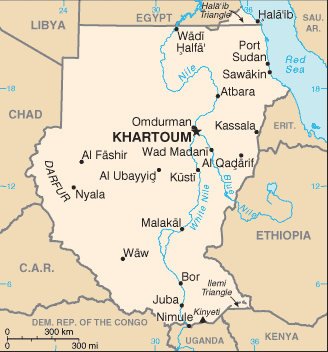
Northern Africa,
bordering the Red Sea, between Egypt and Eritrea
|
|
Geographic
coordinates: |
15 00 N, 30 00 E
|
|
Map references: |
Africa
|
|
Area: |
total:
2,505,810 sq km
land: 2.376 million sq km
water: 129,810 sq km
|
|
Area -
comparative: |
slightly more than
one-quarter the size of the US
|
|
Land boundaries: |
total: 7,687
km
border countries: Central African Republic 1,165 km, Chad
1,360 km, Democratic Republic of the Congo 628 km, Egypt 1,273
km, Eritrea 605 km, Ethiopia 1,606 km, Kenya 232 km, Libya 383
km, Uganda 435 km
|
|
Coastline: |
853 km
|
|
Maritime claims: |
territorial sea:
12 nm
contiguous zone: 18 nm
continental shelf: 200-m depth or to the depth of
exploitation
|
|
Climate: |
tropical in south;
arid desert in north; rainy season varies by region (April to
November)
|
|
Terrain: |
generally flat,
featureless plain; mountains in far south, northeast and west;
desert dominates the north
|
|
Elevation
extremes: |
lowest point:
Red Sea 0 m
highest point: Kinyeti 3,187 m
|
|
Natural
resources: |
petroleum; small
reserves of iron ore, copper, chromium ore, zinc, tungsten,
mica, silver, gold, hydropower
|
|
Land use: |
arable land:
6.83%
permanent crops: 0.18%
other: 92.99% (2001)
|
|
Irrigated land: |
19,500 sq km (1998
est.)
|
|
Natural hazards: |
dust storms and
periodic persistent droughts
|
|
Environment -
current issues: |
inadequate supplies
of potable water; wildlife populations threatened by excessive
hunting; soil erosion; desertification; periodic drought
|
|
Environment -
international agreements: |
party to:
Biodiversity, Climate Change, Climate Change-Kyoto Protocol,
Desertification, Endangered Species, Law of the Sea, Ozone Layer
Protection
signed, but not ratified: none of the selected agreements
|
|
Geography -
note: |
largest country in
Africa; dominated by the Nile and its tributaries
|
|
People |
|
Population: |
40,187,486 (July
2005 est.)
|
|
Age structure: |
0-14 years:
43.2% (male 8,865,331/female 8,488,982)
15-64 years: 54.5% (male 10,952,566/female 10,930,218)
65 years and over: 2.4% (male 513,679/female 436,710)
(2005 est.)
|
|
Median age: |
total: 18.07
years
male: 17.86 years
female: 18.29 years (2005 est.)
|
|
Population
growth rate: |
2.6% (2005 est.)
|
|
Birth rate: |
35.17 births/1,000
population (2005 est.)
|
|
Death rate: |
9.16 deaths/1,000
population (2005 est.)
|
|
Net migration
rate: |
-0.02 migrant(s)/1,000
population (2005 est.)
|
|
Sex ratio: |
at birth:
1.05 male(s)/female
under 15 years: 1.04 male(s)/female
15-64 years: 1 male(s)/female
65 years and over: 1.18 male(s)/female
total population: 1.02 male(s)/female (2005 est.)
|
|
Infant mortality
rate: |
total: 62.5
deaths/1,000 live births
male: 63.29 deaths/1,000 live births
female: 61.67 deaths/1,000 live births (2005 est.)
|
|
Life expectancy
at birth: |
total
population: 58.54 years
male: 57.33 years
female: 59.8 years (2005 est.)
|
|
Total fertility
rate: |
4.85 children
born/woman (2005 est.)
|
|
HIV/AIDS - adult
prevalence rate: |
2.3% (2001 est.)
|
|
HIV/AIDS -
people living with HIV/AIDS: |
400,000 (2001 est.)
|
|
HIV/AIDS -
deaths: |
23,000 (2003 est.)
|
|
Nationality: |
noun:
Sudanese (singular and plural)
adjective: Sudanese
|
|
Ethnic groups: |
black 52%, Arab
39%, Beja 6%, foreigners 2%, other 1%
|
|
Religions: |
Sunni Muslim 70%
(in north), indigenous beliefs 25%, Christian 5% (mostly in
south and Khartoum)
|
|
Languages: |
Arabic (official),
Nubian, Ta Bedawie, diverse dialects of Nilotic, Nilo-Hamitic,
Sudanic languages, English
note: program of "Arabization" in process
|
|
Literacy: |
definition:
age 15 and over can read and write
total population: 61.1%
male: 71.8%
female: 50.5% (2003 est.)
|
|
Government |
|
Country name: |
conventional
long form: Republic of the Sudan
conventional short form: Sudan
local long form: Jumhuriyat as-Sudan
local short form: As-Sudan
former: Anglo-Egyptian Sudan
|
|
Government type: |
authoritarian
regime - ruling military junta took power in 1989; government is
run by an alliance of the military and the National Congress
Party (NCP), formerly the National Islamic Front (NIF), which
espouses an Islamist platform
|
|
Capital: |
Khartoum
|
|
Administrative
divisions: |
26 states (wilayat,
singular - wilayah); A'ali an Nil (Upper Nile), Al Bahr al Ahmar
(Red Sea), Al Buhayrat (Lakes), Al Jazirah (El Gezira), Al
Khartum (Khartoum), Al Qadarif (Gedaref), Al Wahdah (Unity), An
Nil al Abyad (White Nile), An Nil al Azraq (Blue Nile), Ash
Shamaliyah (Northern), Bahr al Jabal (Bahr al Jabal), Gharb al
Istiwa'iyah (Western Equatoria), Gharb Bahr al Ghazal (Western
Bahr al Ghazal), Gharb Darfur (Western Darfur), Gharb Kurdufan
(Western Kordofan), Janub Darfur (Southern Darfur), Janub
Kurdufan (Southern Kordofan), Junqali (Jonglei), Kassala (Kassala),
Nahr an Nil (Nile), Shamal Bahr al Ghazal (Northern Bahr al
Ghazal), Shamal Darfur (Northern Darfur), Shamal Kurdufan
(Northern Kordofan), Sharq al Istiwa'iyah (Eastern Equatoria),
Sinnar (Sinnar), Warab (Warab)
|
|
Independence: |
1 January 1956
(from Egypt and UK)
|
|
National
holiday: |
Independence Day, 1
January (1956)
|
|
Constitution: |
12 April 1973,
suspended following coup of 6 April 1985; interim constitution
of 10 October 1985 suspended following coup of 30 June 1989; new
constitution implemented on 30 June 1998 partially suspended 12
December 1999 by President BASHIR
|
|
Legal system: |
based on English
common law and Islamic law; as of 20 January 1991, the now
defunct Revolutionary Command Council imposed Islamic law in the
northern states; Islamic law applies to all residents of the
northern states regardless of their religion; some separate
religious courts; accepts compulsory ICJ jurisdiction, with
reservations
|
|
Suffrage: |
17 years of age;
universal, but noncompulsory
|
|
Executive
branch: |
chief of state:
President Field Marshall Umar Hassan Ahmad al-BASHIR (since 16
October 1993); First Vice President Salva KIIR (since 4 August
2005), Second Vice President Moses MACHAR (since 12 February
2001); note - the president is both the chief of state and head
of government
head of government: President Field Marshall Umar Hassan
Ahmad al-BASHIR (since 16 October 1993); First Vice President
Salva KIIR (since 4 August 2005), Second Vice President Moses
MACHAR (since 12 February 2001); note - the president is both
the chief of state and head of government
cabinet: Council of Ministers appointed by the president;
note - the National Congress Party or NCP (formerly the National
Islamic Front or NIF) dominates al-BASHIR's cabinet
elections: president elected by popular vote for a
five-year term; election last held 13-23 December 2000 (next to
be held NA)
election results: Field Marshall Umar Hassan Ahmad al-BASHIR
reelected president; percent of vote - Umar Hassan Ahmad al-BASHIR
86.5%, Ja'afar Muhammed NUMAYRI 9.6%, three other candidates
received a combined vote of 3.9%; election widely viewed as
rigged; all popular opposition parties boycotted elections
because of a lack of guarantees for a free and fair election
note: al-BASHIR assumed power as chairman of Sudan's
Revolutionary Command Council for National Salvation (RCC) in
June 1989 and served concurrently as chief of state, chairman of
the RCC, prime minister, and minister of defense until
mid-October 1993 when he was appointed president by the RCC; he
was elected president by popular vote for the first time in
March 1996
|
|
Legislative
branch: |
unicameral National
Assembly (360 seats; 270 popularly elected, 90 elected by supra
assembly of interest groups known as National Congress; members
serve four-year terms)
elections: last held 13-22 December 2000 (next to be held
NA)
election results: NCP 355, others 5
|
|
Judicial branch: |
Supreme Court;
Special Revolutionary Courts
|
|
Political
parties and leaders: |
the government
allows political "associations" under a 1998 law revised in
2000; to obtain government approval parties must accept the
constitution and refrain from advocating or using violence
against the regime; approved parties include the National
Congress Party or NCP [Ibrahim Ahmed UMAR], Popular National
Congress or PNC [Hassan al-TURABI], and over 20 minor,
pro-government parties
|
|
Political
pressure groups and leaders: |
Democratic Unionist
Party [Muhammed Uthman AL-MIRGHANI]; National Democratic
Alliance [Muhammed Uthman AL-MIRGHANI, chairman]; Sudan People's
Liberation Movement/Army [Dr. John GARANG]; Umma Party [Sadiq
al-MAHDI]
|
|
International
organization participation: |
ABEDA, ACP, AfDB,
AFESD, AMF, AU, CAEU, FAO, G-77, IAEA, IBRD, ICAO, ICCt
(signatory), ICRM, IDA, IDB, IFAD, IFC, IFRCS, IGAD, ILO, IMF,
IMO, Interpol, IOC, IOM, ISO, ITU, LAS, MIGA, NAM, OIC, OPCW,
PCA, UN, UNCTAD, UNESCO, UNHCR, UNIDO, UPU, WCO, WFTU, WHO, WIPO,
WMO, WToO, WTO (observer)
|
|
Flag
description: |
three equal
horizontal bands of red (top), white, and black with a green
isosceles triangle based on the hoist side
|
|
Economy |
|
Economy -
overview: |
Sudan has turned
around a struggling economy with sound economic policies and
infrastructure investments, but it still faces formidable
economic problems, starting from its low level of per capita
output. From 1997 to date, Sudan has been implementing IMF
macroeconomic reforms. In 1999, Sudan began exporting crude oil
and in the last quarter of 1999 recorded its first trade
surplus, which, along with monetary policy, has stabilized the
exchange rate. Increased oil production, revived light industry,
and expanded export processing zones helped sustain GDP growth
at 6.4% in 2004. Agriculture production remains Sudan's most
important sector, employing 80% of the work force, contributing
39% of GDP, and accounting for most of GDP growth, but most
farms remain rain-fed and susceptible to drought. Chronic
instability - including the long-standing civil war between the
Muslim north and the Christian/pagan south, adverse weather, and
weak world agricultural prices - ensure that much of the
population will remain at or below the poverty line for years.
|
|
GDP: |
purchasing power
parity - $76.19 billion (2004 est.)
|
|
GDP - real
growth rate: |
6.4% (2004 est.)
|
|
GDP - per
capita: |
purchasing power
parity - $1,900 (2004 est.)
|
|
GDP -
composition by sector: |
agriculture:
38.7%
industry: 20.3%
services: 41% (2003 est.)
|
|
Labor force: |
11 million (1996
est.)
|
|
Labor force - by
occupation: |
agriculture 80%,
industry and commerce 7%, government 13% (1998 est.)
|
|
Unemployment
rate: |
18.7% (2002 est.)
|
|
Population below
poverty line: |
40% (2004 est.)
|
|
Household income
or consumption by percentage share: |
lowest 10%:
NA
highest 10%: NA
|
|
Inflation rate
(consumer prices): |
9% (2004 est.)
|
|
Investment
(gross fixed): |
16% of GDP (2004
est.)
|
|
Budget: |
revenues:
$3.057 billion
expenditures: $2.965 billion, including capital
expenditures of $304 million (2004 est.)
|
|
Public debt: |
79.7% of GDP (2004
est.)
|
|
Agriculture -
products: |
cotton, groundnuts
(peanuts), sorghum, millet, wheat, gum arabic, sugarcane,
cassava (tapioca), mangos, papaya, bananas, sweet potatoes,
sesame; sheep, livestock
|
|
Industries: |
oil, cotton
ginning, textiles, cement, edible oils, sugar, soap distilling,
shoes, petroleum refining, pharmaceuticals, armaments,
automobile/light truck assembly
|
|
Industrial
production growth rate: |
8.5% (1999 est.)
|
|
Electricity -
production: |
2.581 billion kWh
(2002)
|
|
Electricity -
production by source: |
fossil fuel:
52.1%
hydro: 47.9%
nuclear: 0%
other: 0% (2001)
|
|
Electricity -
consumption: |
2.4 billion kWh
(2002)
|
|
Electricity -
exports: |
0 kWh (2002)
|
|
Electricity -
imports: |
0 kWh (2002)
|
|
Oil -
production: |
345,000 bbl/day
(2004 est.)
|
|
Oil -
consumption: |
70,000 bbl/day
(2004 est.)
|
|
Oil - exports: |
275,000 bbl/day
(2004)
|
|
Oil - imports: |
0 bbl/day (2004)
|
|
Oil - proved
reserves: |
1.6 billion bbl
(2004 est.)
|
|
Natural gas -
proved reserves: |
99.11 billion cu m
(2004)
|
|
Current account
balance: |
$-763.6 million
(2004 est.)
|
|
Exports: |
$3.395 billion
f.o.b. (2004 est.)
|
|
Exports -
commodities: |
oil and petroleum
products; cotton, sesame, livestock, groundnuts, gum arabic,
sugar
|
|
Exports -
partners: |
China 64.3%, Japan
13.8%, Saudi Arabia 3.7% (2004)
|
|
Imports: |
$3.496 billion
f.o.b. (2004 est.)
|
|
Imports -
commodities: |
foodstuffs,
manufactured goods, refinery and transport equipment, medicines
and chemicals, textiles, wheat
|
|
Imports -
partners: |
Saudi Arabia 11.7%,
China 10.7%, UAE 6.2%, Egypt 5.2%, Germany 4.9%, India 4.6%,
Australia 4.1%, UK 4% (2004)
|
|
Reserves of
foreign exchange and gold: |
$1.652 billion
(2004 est.)
|
|
Debt - external: |
$21 billion (2004
est.)
|
|
Currency (code): |
Sudanese dinar (SDD)
|
|
Currency code: |
SDD
|
|
Exchange rates: |
Sudanese dinars per
US dollar - 257.91 (2004), 260.98 (2003), 263.31 (2002), 258.7
(2001), 257.12 (2000)
|
|
Fiscal year: |
calendar year
|
|
Communications |
|
Telephones -
main lines in use: |
900,000 (2003)
|
|
Telephones -
mobile cellular: |
650,000 (2003)
|
|
Telephone
system: |
general
assessment: large, well-equipped system by regional
standards and being upgraded; cellular communications started in
1996 and have expanded substantially
domestic: consists of microwave radio relay, cable,
radiotelephone communications, tropospheric scatter, and a
domestic satellite system with 14 earth stations
international: country code - 249; satellite earth
stations - 1 Intelsat (Atlantic Ocean) and 1 Arabsat (2000)
|
|
Radio broadcast
stations: |
AM 12, FM 1,
shortwave 1 (1998)
|
|
Radios: |
7.55 million (1997)
|
|
Television
broadcast stations: |
3 (1997)
|
|
Televisions: |
2.38 million (1997)
|
|
Internet country
code: |
.sd
|
|
Internet hosts: |
NA
|
|
Internet Service
Providers (ISPs): |
2 (2002)
|
|
Internet users: |
300,000 (2003)
|
|
Transportation |
|
Railways: |
total: 5,995
km
narrow gauge: 4,595 km 1.067-m gauge; 1,400 km .600-m
gauge for cotton plantations (2004)
|
|
Highways: |
total:
11,900 km
paved: 4,320 km
unpaved: 7,580 km (1999 est.)
|
|
Waterways: |
4,068 km (1,723 km
open year round on White and Blue Nile rivers) (2004)
|
|
Pipelines: |
gas 156 km; oil
2,365 km; refined products 810 km (2004)
|
|
Ports and
harbors: |
Juba, Khartoum,
Kusti, Malakal, Nimule, Port Sudan, Sawakin
|
|
Merchant marine: |
total: 2
ships (1,000 GRT or over) 20,466 GRT/26,973 DWT
by type: cargo 1, livestock carrier 1
registered in other countries: 2 (2005)
|
|
Airports: |
75 (2004 est.)
|
|
Airports - with
paved runways: |
total: 12
over 3,047 m: 1
2,438 to 3,047 m: 8
1,524 to 2,437 m: 3 (2004 est.)
|
|
Airports - with
unpaved runways: |
total: 63
over 3,047 m: 1
2,438 to 3,047 m: 1
1,524 to 2,437 m: 17
914 to 1,523 m: 33
under 914 m: 11 (2004 est.)
|
|
Heliports: |
2 (2004 est.)
|
|
Military |
|
Military
branches: |
Sudanese People's
Armed Forces (SPAF): Army, Navy, Air Force, Popular Defense
Force
|
|
Military
manpower - military age and obligation: |
18-30 years of age
for compulsory military service; conscript service obligation -
3 years (August 2004)
|
|
Military
manpower - availability: |
males age 18-49:
8,291,695 (2005 est.)
|
|
Military
manpower - fit for military service: |
males age 18-49:
5,427,474 (2005 est.)
|
|
Military
manpower - reaching military age annually: |
males:
442,915 (2005 est.)
|
|
Military
expenditures - dollar figure: |
$587 million (2001
est.) (2004)
|
|
Military
expenditures - percent of GDP: |
3% (1999) (2004)
|
|
Transnational Issues |
|
Disputes -
international: |
the effects of
Sudan's almost constant ethnic and rebel militia fighting since
the mid-twentieth century have penetrated all of its border
states who provide shelter for fleeing refugees and cover to
disparate domestic and foreign conflicting elements; since 2003,
Janjawid armed militia and Sudanese military have driven about
200,000 Darfur region refugees into eastern Chad; large numbers
of Sudanese refugees have also fled to Uganda, Ethiopia, Kenya,
the Central African Republic, and the Democratic Republic of the
Congo; southern Sudan provides shelter to Ugandans seeking
periodic protection from soldiers of the Lord's Resistance Army;
Sudan accuses Eritrea of supporting Sudanese rebel groups;
efforts to demarcate the porous boundary with Ethiopia have been
delayed by civil and ethnic fighting in Sudan; Kenya's
administrative boundary extends into the southern Sudan,
creating the "Ilemi Triangle"; Egypt and Sudan retain claims to
administer triangular areas that extend north and south of the
1899 Treaty boundary along the 22nd Parallel, but have withdrawn
their military presence; Egypt is economically developing the
"Hala'ib Triangle" north of the Treaty Line; periodic violent
skirmishes with Sudanese residents over water and grazing rights
persist among related pastoral populations from the Central
African Republic along the border
|
|
Refugees and
internally displaced persons:: |
refugees
(country of origin): 108,251 (Eritrea) 5,023 (Chad) 7,983
(Uganda)
IDPs: 4.367 million (internal conflict since 1980s;
ongoing genocide) (2004)
|

 100+ Important Documents in United States History