Pray for Pope Francis
Scroll down for topics
 100+ Important Documents in United States History
Apostolic Fathers of the Church
Biographies & Writings of Notable Catholics
Catholic News Commentary by Michael Voris, S.T.B.

(Death, Heaven, Purgatory, Hell)
Links to Churches and Religions
Links to Newspapers, Radio and Television
Links to specialized Catholic News services
General Instruction of the Roman Missal
****
****
****
****
Rite of Christian Initiation for Adults

Visits to this site
Reviving Catholic values
James Kliphuis
10 September 2003
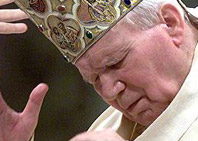 This
Thursday, Pope John Paul II travels to Slovakia. It's his 102nd
foreign trip as pope and his third to Slovakia; in four days, the ailing
83-year old Pontiff intends to visit as many cities in the small Central
European republic and celebrate three masses before hundreds of
thousands of believers. The visit will focus on the role of the church
in an expanding European Union.
This
Thursday, Pope John Paul II travels to Slovakia. It's his 102nd
foreign trip as pope and his third to Slovakia; in four days, the ailing
83-year old Pontiff intends to visit as many cities in the small Central
European republic and celebrate three masses before hundreds of
thousands of believers. The visit will focus on the role of the church
in an expanding European Union.
The Catholic Church is doing well in Slovakia. According to the 2001 census, 84 percent of Slovakia's 5.4 million population believe in God; a large majority of no less than 69 percent of them are Catholics. An additional four percent belong to the Unitarian Greek Orthodox Church, which recognises the authority of the Pope in Rome, although believers worship according to the Byzantine rites.
Since the collapse of communism in 1989, churches in Slovakia are crowded; more churches are being built; a growing number of parents are sending their children to catechism classes; and the number of young candidates for priesthood is increasing. The Catholic Church is more than ever the dominant moral authority in the country in discussions on abortion, euthanasia, and the role of the family.
|

The brittle government coalition of Slovak Prime Minister Mikulas Dzurinda is under constant pressure from the Christian democrat parties to introduce stricter rules for abortion; the arch-conservative KDH (Christian Democrat Party) wields far more influence in these matters than its 10 percent support at last year's elections would seem to warrant.
The role as moral arbiter is something relatively new for the Church in Slovakia. Under Communism, it fulfilled no such role: except for some individuals, two of whom the Pope is to beatify in the coming days, the Slovak Church never attempted to fight off the relentless ideological pressure exerted by Communism; it limited itself to passive resistance.
|
For decades after World War II, the Slovak Church had been in a very delicate position. Its behaviour when Nazi Germany set up a puppet fascist régime in Slovakia between 1939 and 1945 had been controversial to put it mildly. The régime, headed by a Catholic priest, Josef Tiso (a Slovak nationalist who fought the post-World War I creation of Czechoslovakia tooth and nail) was condemned by the Vatican many times. Even so, the Slovak puppet administration did nothing – for instance to prevent the extermination of Slovak Jews.
When the Polish cardinal Karol Woytila was elected Pope in 1978, Slovaks, like the Poles, soon came to see him as a major force against the Communist régime, especially when in the early 80s the Pope came out in support of the Polish Solidarnosc popular movement. With Communism evaporating, the Polish Pope made it possible for Slovak Catholics freely to reaffirm their support for their Church.
|
There can be little doubt that Pope John Paul II envisages a special role for the countries in Central Europe as they prepare to join the European Union. Countries like Poland and Slovakia, where the influence of the Catholic Church pervades every nook and cranny of society, will help emphasize Christian values, and affirm Christian roots in – for instance – the text of the proposed European Union constitution.
Most West-European countries are set to secular norms, with divorce and abortion being legalized years ago, and homosexual marriages becoming widely accepted. In the European Parliament, voices were at times raised saying that candidates should - for example - legalise abortion to show they were fit for membership. Such West-European pronouncements made devout Catholics in Slovakia and Poland wonder whether they should vote in favour of EU membership in the referenda on the issue held earlier this year.
Last year in Krakow, in his native Poland, the Pope warned against what he sees as evils of unbridled Western-style secularism. This year, on a visit to Croatia, the Pope called on the faithful to defend "God's authentic plan" for the family – in other words, no abortion, no divorce, no gay marriages.
|
No doubt the Pontiff will have a similar message for the Slovaks. It is clear that the Pope sees the arrival in the EU of countries of arch-believers like Slovakia, Poland, and at a later date Croatia, as of crucial importance to the future of Europe. In this view, Christian values should be reaffirmed and strengthened with the EU's eastward expansion – especially in view of the possible membership issue of Turkey, a secular yet Muslim-dominated country.
The
Pope's European agenda is described as aiming to re-insert traditional
Catholic morality into a unified Europe. The next few days in Slovakia
will demonstrate how the 83-year old John Paul II goes about that job.