Pray for Pope Francis
Scroll down for topics
 100+ Important Documents in United States History
Apostolic Fathers of the Church
Biographies & Writings of Notable Catholics
Catholic News Commentary by Michael Voris, S.T.B.

(Death, Heaven, Purgatory, Hell)
Links to Churches and Religions
Links to Newspapers, Radio and Television
Links to specialized Catholic News services
General Instruction of the Roman Missal
****
****
****
****
Rite of Christian Initiation for Adults

Visits to this site
Churches of St. Petersburg
Unlike Moscow, St.Petersburg of the early 20th century could not boast many churches. By the year 1910 the city and its suburbs had about 480 churches of every description – at monasteries, cemeteries, private homes, prisons, hospitals, government departments and educational establishments. Along with Orthodox churches and numerous chapels St. Petersburg had 10 Old-Believers churches and about 50 churches of other confessions.
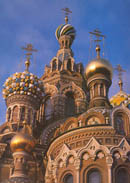 Every
day St. Petersburg would wake up to church chiming,
particularly on religious and national holidays. On Christmas and Easter nights
the pealing was unforgettably loud and solemn.
Every
day St. Petersburg would wake up to church chiming,
particularly on religious and national holidays. On Christmas and Easter nights
the pealing was unforgettably loud and solemn.
Top government
officials, military men and members of the nobility flocked to the Winter Palace
for the Easter Morning Prayer. Three gunshots from Peter and Paul Fortress
heralded arrival time – 11 p.m., the beginning of the service – 11.30 and the
procession of the cross, which commenced at midnight. The Emperor and Empress
were in the Hall of Ceremonies exchanging Easter salutations with relatives,
children and guards and swapping Easter eggs, with some - exquisite silver ones,
from Faberge, and with others – plain motley painted ones, made of wood. Church
ringing on the occasion of the good tidings continued day after day throughout
the whole of the Easter Week. 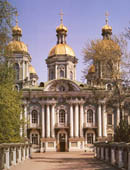
The chiming of St.Petersburg bells by far surpassed that of bells in Moscow and Rostov. Church bells in St.Petersburg were made of special alloys and the bell-casting process followed a particular tradition: the founders had to observe a fast and pray continuously several days in advance. At nighttime their families and neighbours gathered for what was known as “ringing”, that is, telling all sorts of cock-and-bull stories and recounting incredible incidents. The casting of bells was seen as a God-pleasing affair. The craftsmen washed and put on clean shirts on the eve of it. And the process could not be attended by drunks, adulterers, people who had not confessed their sins, and also dogs - such presences could hamper the success of the enterprise.
Major church holidays, such as Christmas, Epiphany, Trinity Sunday, were celebrated with solemnity. Days of saints were particular occasions. Each church had a saint, a holiday. Day of St.Alexander Nevsky – August 30th – was a citywide holiday with a procession of the cross marching from St.Isaac’s and Kazansky Cathedrals to the Holy Trinity Alexander Nevsky Laura to bow to the silver shrine with the saint’s relics.
The main cathedral of St.Petersburg was St.Isaac’s Cathedral, which could take 12000 people. On anniversaries of Russian war victories the cathedral hosted thanks-giving services.
The Peter and Paul Cathedral in the Peter and Paul Fortress was mostly dedicated to the imperial family. There they read burial services for czars and grand princes and the burial vault of the royal family was there too.
The Kazansky Cathedral was noted for a major shrine of St.Petersburg – the Icon of Our Lady of Kazan, which once served to bless the reign of the first czar of the Romanov family – Mikhail. All czars visited the cathedral to bow to the icon.
Along with Orthodox churches, St.Petersburg had churches belonging to other confessions. A witty comment popular in the middle of the 19th century said Nevsky Prospekt was a model of religious tolerance: a small section of the Prospekt housed an Orthodox, a Catholic, two Lutheran (German and Dutch) and an Armenian church. A census that was conducted on the eve of the year 1900 revealed that the most numerous of the non-Russians living in St.Petersburg were Germans, of which it counted nearly 48.500 people. Germans had come to settle in the city during the reign of Peter I and played an important role in business and trade. There were Lutheran German churches in downtown Petersburg: St.Peter’s Church and St.Anne’s Church. Both churches were also famous for schools that taught in German and opened their doors to Orthodox believers too.
Poles were the second largest non-Russian group in St.Petersburg after Germans – over 45 thousand people, predominantly military men, functionaries, students and nobility. Poles and other Catholics went to pray in the old St.Catherine’s Church on Nevsky, built in the reign of Empress Catherine in the second half of the 18th century.
St.Petersburg
was the hub of Russia’s religious life providing the management of church
affairs. The early 20th century saw a departure from religious teachings. The
intellectuals were searching for new ways of spiritual development and the
church itself was torn apart by conflicting views within its midst. All this
produced a negative impact on the country’s future.
Copyright© The Voice of Russia, 2003