|
Introduction |
|
ackground: |
Poland is an
ancient nation that was conceived near the middle of the 10th
century. Its golden age occurred in the 16th century. During the
following century, the strengthening of the gentry and internal
disorders weakened the nation. In a series of agreements between
1772 and 1795, Russia, Prussia, and Austria partitioned Poland
amongst themselves. Poland regained its independence in 1918
only to be overrun by Germany and the Soviet Union in World War
II. It became a Soviet satellite state following the war, but
its government was comparatively tolerant and progressive. Labor
turmoil in 1980 led to the formation of the independent trade
union "Solidarity" that over time became a political force and
by 1990 had swept parliamentary elections and the presidency. A
"shock therapy" program during the early 1990s enabled the
country to transform its economy into one of the most robust in
Central Europe, but Poland currently suffers low GDP growth and
high unemployment. Solidarity suffered a major defeat in the
2001 parliamentary elections when it failed to elect a single
deputy to the lower house of Parliament, and the new leaders of
the Solidarity Trade Union subsequently pledged to reduce the
Trade Union's political role. Poland joined NATO in 1999 and the
European Union in 2004.
|
|
Geography |
|
Location: |
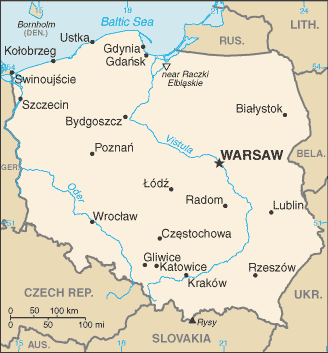
Central Europe,
east of Germany
|
|
Geographic
coordinates: |
52 00 N, 20 00 E
|
|
Map references: |
Europe
|
|
Area: |
total:
312,685 sq km
land: 304,465 sq km
water: 8,220 sq km
|
|
Area -
comparative: |
slightly smaller
than New Mexico
|
|
Land boundaries: |
total: 2,788
km
border countries: Belarus 407 km, Czech Republic 658 km,
Germany 456 km, Lithuania 91 km, Russia (Kaliningrad Oblast) 206
km, Slovakia 444 km, Ukraine 526 km
|
|
Coastline: |
491 km
|
|
Maritime claims: |
territorial sea:
12 nm
exclusive economic zone: defined by international
treaties
|
|
Climate: |
temperate with
cold, cloudy, moderately severe winters with frequent
precipitation; mild summers with frequent showers and
thundershowers
|
|
Terrain: |
mostly flat plain;
mountains along southern border
|
|
Elevation
extremes: |
lowest point:
near Raczki Elblaskie -2 m
highest point: Rysy 2,499 m
|
|
Natural
resources: |
coal, sulfur,
copper, natural gas, silver, lead, salt, amber, arable land
|
|
Land use: |
arable land:
45.91%
permanent crops: 1.12%
other: 52.97% (2001)
|
|
Irrigated land: |
1,000 sq km (1998
est.)
|
|
Natural hazards: |
flooding
|
|
Environment -
current issues: |
situation has
improved since 1989 due to decline in heavy industry and
increased environmental concern by post-Communist governments;
air pollution nonetheless remains serious because of sulfur
dioxide emissions from coal-fired power plants, and the
resulting acid rain has caused forest damage; water pollution
from industrial and municipal sources is also a problem, as is
disposal of hazardous wastes; pollution levels should continue
to decrease as industrial establishments bring their facilities
up to European Union code, but at substantial cost to business
and the government
|
|
Environment -
international agreements: |
party to:
Air Pollution, Antarctic-Environmental Protocol,
Antarctic-Marine Living Resources, Antarctic Seals, Antarctic
Treaty, Biodiversity, Climate Change, Climate Change-Kyoto
Protocol, Desertification, Endangered Species, Environmental
Modification, Hazardous Wastes, Kyoto Protocol, Law of the Sea,
Marine Dumping, Ozone Layer Protection, Ship Pollution, Wetlands
signed, but not ratified: Air Pollution-Nitrogen Oxides,
Air Pollution-Persistent Organic Pollutants, Air
Pollution-Sulfur 94
|
|
Geography -
note: |
historically, an
area of conflict because of flat terrain and the lack of natural
barriers on the North European Plain
|
|
People |
|
Population: |
38,635,144 (July
2005 est.)
|
|
Age structure: |
0-14 years:
16.7% (male 3,319,176/female 3,150,859)
15-64 years: 70.3% (male 13,506,153/female 13,638,265)
65 years and over: 13% (male 1,912,431/female 3,108,260)
(2005 est.)
|
|
Median age: |
total: 36.43
years
male: 34.52 years
female: 38.49 years (2005 est.)
|
|
Population
growth rate: |
0.03% (2005 est.)
|
|
Birth rate: |
10.78 births/1,000
population (2005 est.)
|
|
Death rate: |
10.01 deaths/1,000
population (2005 est.)
|
|
Net migration
rate: |
-0.49 migrant(s)/1,000
population (2005 est.)
|
|
Sex ratio: |
at birth:
1.06 male(s)/female
under 15 years: 1.05 male(s)/female
15-64 years: 0.99 male(s)/female
65 years and over: 0.62 male(s)/female
total population: 0.94 male(s)/female (2005 est.)
|
|
Infant mortality
rate: |
total: 8.51
deaths/1,000 live births
male: 9.59 deaths/1,000 live births
female: 7.37 deaths/1,000 live births (2005 est.)
|
|
Life expectancy
at birth: |
total
population: 74.41 years
male: 70.3 years
female: 78.76 years (2005 est.)
|
|
Total fertility
rate: |
1.39 children
born/woman (2005 est.)
|
|
HIV/AIDS - adult
prevalence rate: |
0.1% ; note - no
country specific models provided (2001 est.)
|
|
HIV/AIDS -
people living with HIV/AIDS: |
14,000 (2003 est.)
|
|
HIV/AIDS -
deaths: |
100 (2001 est.)
|
|
Nationality: |
noun: Pole(s)
adjective: Polish
|
|
Ethnic groups: |
Polish 96.7%,
German 0.4%, Belarusian 0.1%, Ukrainian 0.1%, other and
unspecified 2.7% (2002 census)
|
|
Religions: |
Roman Catholic
89.8% (about 75% practicing), Eastern Orthodox 1.3%, Protestant
0.3%, other 0.3%, unspecified 8.3% (2002)
|
|
Languages: |
Polish 97.8%, other
and unspecified 2.2% (2002 census)
|
|
Literacy: |
definition:
age 15 and over can read and write
total population: 99.8%
male: 99.8%
female: 99.7% (2003 est.)
|
|
Government |
|
Country name: |
conventional
long form: Republic of Poland
conventional short form: Poland
local long form: Rzeczpospolita Polska
local short form: Polska
|
|
Government type: |
republic
|
|
Capital: |
Warsaw
|
|
Administrative
divisions: |
16 provinces (wojewodztwa,
singular - wojewodztwo); Dolnoslaskie, Kujawsko-Pomorskie,
Lodzkie, Lubelskie, Lubuskie, Malopolskie, Mazowieckie, Opolskie,
Podkarpackie, Podlaskie, Pomorskie, Slaskie, Swietokrzyskie,
Warminsko-Mazurskie, Wielkopolskie, Zachodniopomorskie
|
|
Independence: |
11 November 1918
(independent republic proclaimed)
|
|
National
holiday: |
Constitution Day, 3
May (1791)
|
|
Constitution: |
adopted by the
National Assembly 2 April 1997; passed by national referendum 25
May 1997; effective 17 October 1997
|
|
Legal system: |
mixture of
Continental (Napoleonic) civil law and holdover Communist legal
theory; changes being gradually introduced as part of broader
democratization process; limited judicial review of legislative
acts, but rulings of the Constitutional Tribunal are final;
court decisions can be appealed to the European Court of Justice
in Strasbourg
|
|
Suffrage: |
18 years of age;
universal
|
|
Executive
branch: |
chief of state:
President Aleksander KWASNIEWSKI (since 23 December 1995)
head of government: Prime Minister Marek BELKA (since 24
June 2004); Deputy Prime Minister Izabela JARUGA-NOWACKA (since
24 June 2004)
cabinet: Council of Ministers responsible to the prime
minister and the Sejm; the prime minister proposes, the
president appoints, and the Sejm approves the Council of
Ministers
elections: president elected by popular vote for a
five-year term; election last held 8 October 2000 (next to be
held October 2005); prime minister and deputy prime ministers
appointed by the president and confirmed by the Sejm
election results: Aleksander KWASNIEWSKI reelected
president; percent of popular vote - Aleksander KWASNIEWSKI
53.9%, Andrzej OLECHOWSKI 17.3%, Marian KRZAKLEWSKI 15.6%, Lech
WALESA 1%
|
|
Legislative
branch: |
bicameral
legislature consisting of an upper house, the Senate or Senat
(100 seats; members are elected by a majority vote on a
provincial basis to serve four-year terms), and a lower house,
the Sejm (460 seats; members are elected under a complex system
of proportional representation to serve four-year terms); the
designation of National Assembly or Zgromadzenie Narodowe is
only used on those rare occasions when the two houses meet
jointly
elections: Senate - last held 23 September 2001 (next to
be held by September 2005); Sejm elections last held 23
September 2001 (next to be held by September 2005)
election results: Senate - percent of vote by party -
NA%; seats by party (as of 1 March 2005) - SLD-UP 59, Block
Senate 2001 8, SDPL 9, UW 5, LPR 5, PSL 4, SO 3, PO 3, PiS 2,
independents 2; Sejm - percent of vote by party - SLD-UP 41%, PO
12.7%, SO 10.2%, PiS 9.5%, PSL 9%, LPR 7.9%, AWSP 5.6% UW 3.1%,
other 1%; seats by party (as of 1 March 2005) - SLD 150, PO 56,
PiS 46, PSL 40, SDPL 32, SO 30, LPR 25, UP 13, PLD 11, KL 5, RKN
5, Dom Ojczysty 5, PP 3, ROP 3, German minorities 2,
independents 34
note: two seats are assigned to ethnic minority parties
in the Sejm only
|
|
Judicial branch: |
Supreme Court
(judges are appointed by the president on the recommendation of
the National Council of the Judiciary for an indefinite period);
Constitutional Tribunal (judges are chosen by the Sejm for
nine-year terms)
|
|
Political
parties and leaders: |
Catholic-National
Movement or RKN [Antoni MACIEREWICZ]; Civic Platform or PO
[Donald TUSK]; Conservative Peasants Party or KL [Artur BALAZS];
Democratic Left Alliance or SLD [Jozef OLEKSY]; Dom Ojczysty
(Fatherland Home); Freedom Union or UW [Wladyslaw FRASYNIUK];
German Minority of Lower Silesia or MNSO [Henryk KROLL]; Law and
Justice or PiS [Jaroslaw KACZYNSKI]; League of Polish Families
or LPR [Marek KOTLINOWSKI]; Movement for the Reconstruction of
Poland or ROP [Jan OLSZEWSKI]; Peasant-Democratic Party or PLD
[Roman JAGIELINSKI]; Polish Accord or PP [Jan LOPUSZANSKI];
Polish Peasant Party or PSL [Waldemar PAWLAK]; Samoobrona or SO
[Andrzej LEPPER]; Social Democratic Party of Poland or SDPL [Marek
BOROWSKI]; Social Movement or RS [Krzysztof PIESIEWICZ]; Union
of Labor or UP [Izabela JARUGA-NOWACKA]
|
|
Political
pressure groups and leaders: |
All Poland Trade
Union Alliance or OPZZ (trade union) [Jan GUZ]; Roman Catholic
Church [Cardinal Jozef GLEMP]; Solidarity Trade Union [Janusz
SNIADEK]
|
|
International
organization participation: |
ACCT (observer),
Australia Group, BIS, BSEC (observer), CBSS, CE, CEI, CERN, EAPC,
EBRD, EIB, EU (new member), FAO, IAEA, IBRD, ICAO, ICC, ICCt,
ICFTU, ICRM, IDA, IFC, IFRCS, IHO, ILO, IMF, IMO, Interpol, IOC,
IOM, ISO, ITU, MIGA, MINURSO, MONUC, NAM (guest), NATO, NSG, OAS
(observer), OECD, OPCW, OSCE, PCA, UN, UNCTAD, UNDOF, UNESCO,
UNHCR, UNIDO, UNIFIL, UNMEE, UNMIK, UNMIL, UNOCI, UNOMIG, UPU,
WCL, WCO, WEU (member affiliate), WFTU, WHO, WIPO, WMO, WToO,
WTO, ZC
|
|
Flag
description: |
two equal
horizontal bands of white (top) and red; similar to the flags of
Indonesia and Monaco which are red (top) and white
|
|
Economy |
|
Economy -
overview: |
Poland has
steadfastly pursued a policy of economic liberalization
throughout the 1990s and today stands out as a success story
among transition economies. Even so, much remains to be done,
especially in bringing down unemployment. The privatization of
small and medium-sized state-owned companies and a liberal law
on establishing new firms has encouraged the development of the
private business sector, but legal and bureaucratic obstacles
alongside persistent corruption are hampering its further
development. Poland's agricultural sector remains handicapped by
surplus labor, inefficient small farms, and lack of investment.
Restructuring and privatization of "sensitive sectors" (e.g.,
coal, steel, railroads, and energy), while recently initiated,
have stalled. Reforms in health care, education, the pension
system, and state administration have resulted in
larger-than-expected fiscal pressures. Further progress in
public finance depends mainly on reducing losses in Polish state
enterprises, restraining entitlements, and overhauling the tax
code to incorporate the growing gray economy and farmers, most
of whom pay no tax. The government has introduced a package of
social and administrative spending cuts to reduce public
spending by about $17 billion through 2007. Additional
reductions are under discussion in the legislature but could be
trumped by election-year politics in 2005. Poland joined the EU
in May 2004, and surging exports to the EU contributed to
Poland's strong growth in 2004, though its competitiveness could
be threatened by the zloty's appreciation. GDP per capita
roughly equals that of the three Baltic states. Poland stands to
benefit from nearly $13.5 billion in EU funds, available through
2006. Farmers have already begun to reap the rewards of
membership via higher food prices and EU agricultural subsidies.
|
|
GDP: |
purchasing power
parity - $463 billion (2004 est.)
|
|
GDP - real
growth rate: |
5.6% (2004 est.)
|
|
GDP - per
capita: |
purchasing power
parity - $12,000 (2004 est.)
|
|
GDP -
composition by sector: |
agriculture:
2.9%
industry: 31.3%
services: 65.9% (2004 est.)
|
|
Labor force: |
17.02 million (2004
est.)
|
|
Labor force - by
occupation: |
agriculture 16.1%,
industry 29%, services 54.9% (2002)
|
|
Unemployment
rate: |
19.5% (2004 est.)
|
|
Population below
poverty line: |
18.4% (2000 est.)
|
|
Household income
or consumption by percentage share: |
lowest 10%:
3.2%
highest 10%: 24.7% (1998)
|
|
Distribution of
family income - Gini index: |
31.6 (1998)
|
|
Inflation rate
(consumer prices): |
3.4% (2004 est.)
|
|
Investment
(gross fixed): |
18.4% of GDP (2004
est.)
|
|
Budget: |
revenues:
$44.52 billion
expenditures: $54.93 billion, including capital
expenditures of NA (2004 est.)
|
|
Public debt: |
49.9% of GDP (2004
est.)
|
|
Agriculture -
products: |
potatoes, fruits,
vegetables, wheat; poultry, eggs, pork
|
|
Industries: |
machine building,
iron and steel, coal mining, chemicals, shipbuilding, food
processing, glass, beverages, textiles
|
|
Industrial
production growth rate: |
10% (2004 est.)
|
|
Electricity -
production: |
133.8 billion kWh
(2002)
|
|
Electricity -
production by source: |
fossil fuel:
98.1%
hydro: 1.5%
nuclear: 0%
other: 0.4% (2001)
|
|
Electricity -
consumption: |
117.4 billion kWh
(2002)
|
|
Electricity -
exports: |
11.5 billion kWh
(2002)
|
|
Electricity -
imports: |
4.5 billion kWh
(2002)
|
|
Oil -
production: |
17,180 bbl/day
(2001 est.)
|
|
Oil -
consumption: |
424,100 bbl/day
(2001 est.)
|
|
Oil - exports: |
53,000 bbl/day
(2001)
|
|
Oil - imports: |
413,700 bbl/day
(2001)
|
|
Oil - proved
reserves: |
116.4 million bbl
(1 January 2002)
|
|
Natural gas -
production: |
5.471 billion cu m
(2001 est.)
|
|
Natural gas -
consumption: |
13.85 billion cu m
(2001 est.)
|
|
Natural gas -
exports: |
41 million cu m
(2001 est.)
|
|
Natural gas -
imports: |
8.782 billion cu m
(2001 est.)
|
|
Natural gas -
proved reserves: |
154.4 billion cu m
(1 January 2002)
|
|
Current account
balance: |
$-3.831 billion
(2004 est.)
|
|
Exports: |
$75.98 billion
f.o.b. (2004 est.)
|
|
Exports -
commodities: |
machinery and
transport equipment 37.8%, intermediate manufactured goods
23.7%, miscellaneous manufactured goods 17.1%, food and live
animals 7.6% (2003)
|
|
Exports -
partners: |
Germany 29.8%,
Italy 6.3%, France 5.4%, UK 4.7%, Czech Republic 4.4% (2004)
|
|
Imports: |
$81.61 billion
f.o.b. (2004 est.)
|
|
Imports -
commodities: |
machinery and
transport equipment 38%, intermediate manufactured goods 21%,
chemicals 14.8%, minerals, fuels, lubricants, and related
materials 9.1% (2003)
|
|
Imports -
partners: |
Germany 29.8%,
Italy 8%, France 7%, Russia 6.9%, Netherlands 5.3%, Belgium 4.2%
(2004)
|
|
Reserves of
foreign exchange and gold: |
$41.88 billion
(2004 est.)
|
|
Debt - external: |
$99.15 billion
(2004 est.)
|
|
Currency (code): |
zloty (PLN)
|
|
Currency code: |
PLN
|
|
Exchange rates: |
zlotych per US
dollar - 3.6576 (2004), 3.8891 (2003), 4.08 (2002), 4.0939
(2001), 4.3461 (2000)
note: zlotych is the plural form of zloty
|
|
Fiscal year: |
calendar year
|
|
Communications |
|
Telephones -
main lines in use: |
12.3 million (2003)
|
|
Telephones -
mobile cellular: |
17.401 million
(2003)
|
|
Telephone
system: |
general
assessment: underdeveloped and outmoded system in the
process of being overhauled; partial privatization of the
state-owned telephone monopoly is underway; the long waiting
list for main line telephone service has resulted in a boom in
mobile cellular telephone use
domestic: cable, open-wire, and microwave radio relay; 3
cellular networks; local exchanges 56.6% digital
international: country code - 48; satellite earth
stations - 2 Intelsat, NA Eutelsat, 2 Inmarsat (Atlantic and
Indian Ocean regions), and 1 Intersputnik (Atlantic Ocean
region)
|
|
Radio broadcast
stations: |
AM 14, FM 777,
shortwave 1 (1998)
|
|
Radios: |
20.2 million (1997)
|
|
Television
broadcast stations: |
179 (plus 256
repeaters) (September 1995)
|
|
Televisions: |
13.05 million
(1997)
|
|
Internet country
code: |
.pl
|
|
Internet hosts: |
804,915 (2004)
|
|
Internet Service
Providers (ISPs): |
19 (2000)
|
|
Internet users: |
8.97 million (2003)
|
|
Transportation |
|
Railways: |
total:
23,852 km
broad gauge: 629 km 1.524-m gauge
standard gauge: 23,223 km 1.435-m gauge (20,555 km
operational) (11,962 km electrified) (2004)
|
|
Highways: |
total:
364,697 km
paved: 249,088 km (including 399 km of expressways)
unpaved: 115,609 km (2001)
|
|
Waterways: |
3,997 km (navigable
rivers and canals) (2003)
|
|
Pipelines: |
gas 13,552 km; oil
1,772 km (2004)
|
|
Ports and
harbors: |
Gdansk, Gdynia,
Gliwice, Kolobrzeg, Szczecin, Swinoujscie, Ustka, Warsaw,
Wroclaw
|
|
Merchant marine: |
total: 7
ships (1,000 GRT or over) 154,710 GRT/228,132 DWT
by type: cargo 3, chemical tanker 2, passenger/cargo 1,
roll on/roll off 1
registered in other countries: 107 (2005)
|
|
Airports: |
123 (2004 est.)
|
|
Airports - with
paved runways: |
total: 84
over 3,047 m: 3
2,438 to 3,047 m: 30
1,524 to 2,437 m: 40
914 to 1,523 m: 8
under 914 m: 3 (2004 est.)
|
|
Airports - with
unpaved runways: |
total: 39
2,438 to 3,047 m: 1
1,524 to 2,437 m: 4
914 to 1,523 m: 13
under 914 m: 21 (2004 est.)
|
|
Heliports: |
3 (2004 est.)
|
|
Military |
|
Military
branches: |
Land Forces, Navy,
Polish Air Force (PSP)
|
|
Military
manpower - military age and obligation: |
17 years of age for
compulsory military service after January 1st of the year of
18th birthday; 17 years of age for voluntary military service;
in 2005 Poland plans to shorten the length of conscript service
obligation from 12 to 9 months; by 2008, plans call for at least
60% of military personnel to be volunteers; only soldiers who
have completed their conscript service are allowed to volunteer
for professional service; as of April 2004 women are only
allowed to serve as officers and non-commissioned officers
(April 2004)
|
|
Military
manpower - availability: |
males age 17-49:
9,673,712 (2005 est.)
|
|
Military
manpower - fit for military service: |
males age 17-49:
7,740,164 (2005 est.)
|
|
Military
manpower - reaching military age annually: |
males:
275,521 (2005 est.)
|
|
Military
expenditures - dollar figure: |
$3.5 billion (2002)
|
|
Military
expenditures - percent of GDP: |
1.71% (2002)
|
|
Transnational Issues |
|
Disputes -
international: |
as a member state
that forms part of the EU's external border, Poland must
implement the strict Schengen border rules
|
|
Illicit drugs: |
major illicit
producer of synthetic drugs for the international market; minor
transshipment point for Asian and Latin American illicit drugs
to Western Europe
|
 100+ Important Documents in United States History