|
Introduction |
|
Background: |
In 1970, QABOOS bin Said
Al Said ousted his father and has ruled as sultan ever since.
His extensive modernization program has opened the country to
the outside world and has preserved a long-standing political
and military relationship with the UK. Oman's moderate,
independent foreign policy has sought to maintain good relations
with all Middle Eastern countries.
|
|
Geography |
|
Location: |
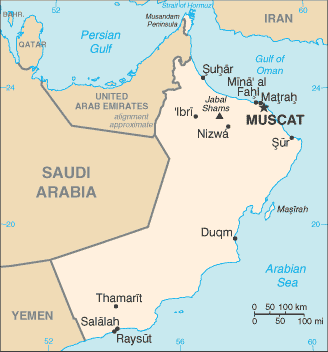
Middle East, bordering the
Arabian Sea, Gulf of Oman, and Persian Gulf, between Yemen and
UAE
|
|
Geographic coordinates: |
21 00 N, 57 00 E
|
|
Map
references: |
Middle East
|
|
Area: |
total: 212,460 sq
km
land: 212,460 sq km
water: 0 sq km
|
|
Area -
comparative: |
slightly smaller than
Kansas
|
|
Land
boundaries: |
total: 1,374 km
border countries: Saudi Arabia 676 km, UAE 410 km, Yemen
288 km
|
|
Coastline: |
2,092 km
|
|
Maritime claims: |
territorial sea: 12
nm
contiguous zone: 24 nm
exclusive economic zone: 200 nm
|
|
Climate: |
dry desert; hot, humid
along coast; hot, dry interior; strong southwest summer monsoon
(May to September) in far south
|
|
Terrain: |
central desert plain,
rugged mountains in north and south
|
|
Elevation extremes: |
lowest point:
Arabian Sea 0 m
highest point: Jabal Shams 2,980 m
|
|
Natural
resources: |
petroleum, copper,
asbestos, some marble, limestone, chromium, gypsum, natural gas
|
|
Land
use: |
arable land: 0.12%
permanent crops: 0.14%
other: 99.74% (2001)
|
|
Irrigated land: |
620 sq km (1998 est.)
|
|
Natural
hazards: |
summer winds often raise
large sandstorms and dust storms in interior; periodic droughts
|
|
Environment - current issues: |
rising soil salinity;
beach pollution from oil spills; very limited natural fresh
water resources
|
|
Environment - international agreements: |
party to:
Biodiversity, Climate Change, Climate Change-Kyoto Protocol,
Desertification, Hazardous Wastes, Law of the Sea, Marine
Dumping, Ozone Layer Protection, Ship Pollution, Whaling
signed, but not ratified: none of the selected agreements
|
|
Geography - note: |
strategic location on
Musandam Peninsula adjacent to Strait of Hormuz, a vital transit
point for world crude oil
|
|
People |
|
Population: |
3,001,583
note: includes 577,293 non-nationals (July 2005 est.)
|
|
Age
structure: |
0-14 years: 42.6%
(male 652,028/female 626,698)
15-64 years: 54.9% (male 978,183/female 668,814)
65 years and over: 2.5% (male 41,366/female 34,494) (2005
est.)
|
|
Median
age: |
total: 19.13 years
male: 21.88 years
female: 16.45 years (2005 est.)
|
|
Population growth rate: |
3.32% (2005 est.)
|
|
Birth
rate: |
36.73 births/1,000
population (2005 est.)
|
|
Death
rate: |
3.86 deaths/1,000
population (2005 est.)
|
|
Net
migration rate: |
0.31 migrant(s)/1,000
population (2005 est.)
|
|
Sex
ratio: |
at birth: 1.05
male(s)/female
under 15 years: 1.04 male(s)/female
15-64 years: 1.46 male(s)/female
65 years and over: 1.2 male(s)/female
total population: 1.26 male(s)/female (2005 est.)
|
|
Infant
mortality rate: |
total: 19.51
deaths/1,000 live births
male: 22.35 deaths/1,000 live births
female: 16.53 deaths/1,000 live births (2005 est.)
|
|
Life
expectancy at birth: |
total population:
73.13 years
male: 70.92 years
female: 75.46 years (2005 est.)
|
|
Total
fertility rate: |
5.84 children born/woman
(2005 est.)
|
|
HIV/AIDS - adult prevalence rate: |
0.1% (2001 est.)
|
|
HIV/AIDS - people living with HIV/AIDS: |
1,300 (2001 est.)
|
|
HIV/AIDS - deaths: |
less than 200 (2003 est.)
|
|
Nationality: |
noun: Omani(s)
adjective: Omani
|
|
Ethnic
groups: |
Arab, Baluchi, South Asian
(Indian, Pakistani, Sri Lankan, Bangladeshi), African
|
|
Religions: |
Ibadhi Muslim 75%, Sunni
Muslim, Shi'a Muslim, Hindu
|
|
Languages: |
Arabic (official),
English, Baluchi, Urdu, Indian dialects
|
|
Literacy: |
definition: NA
total population: 75.8%
male: 83.1%
female: 67.2% (2003 est.)
|
|
Government |
|
Country
name: |
conventional long form:
Sultanate of Oman
conventional short form: Oman
local long form: Saltanat Uman
local short form: Uman
former: Muscat and Oman
|
|
Government type: |
monarchy
|
|
Capital: |
Muscat
|
|
Administrative divisions: |
5 regions (manaatiq,
singular - mintaqat) and 3 governorates* (muhaafazaat, singular
- muhaafaza) Ad Dakhiliyah, Al Batinah, Al Wusta, Ash Sharqiyah,
Az Zahirah, Masqat*, Musandam*, Zufar*
|
|
Independence: |
1650 (expulsion of the
Portuguese)
|
|
National holiday: |
Birthday of Sultan QABOOS,
18 November (1940)
|
|
Constitution: |
none; note - on 6 November
1996, Sultan QABOOS issued a royal decree promulgating a basic
law considered by the government to be a constitution which,
among other things, clarifies the royal succession, provides for
a prime minister, bars ministers from holding interests in
companies doing business with the government, establishes a
bicameral legislature, and guarantees basic civil liberties for
Omani citizens
|
|
Legal
system: |
based on English common
law and Islamic law; ultimate appeal to the monarch; has not
accepted compulsory ICJ jurisdiction
|
|
Suffrage: |
in Oman's most recent
Majlis al-Shura elections in 2003, suffrage was universal for
all Omanis over age 21 except for members of the military and
security forces; the next Majlis al-Shura elections are
scheduled for 2007
|
|
Executive branch: |
chief of state:
Sultan and Prime Minister QABOOS bin Said Al Said (since 23 July
1970); note - the monarch is both the chief of state and head of
government
head of government: Sultan and Prime Minister QABOOS bin
Said Al Said (since 23 July 1970); note - the monarch is both
the chief of state and head of government
cabinet: Cabinet appointed by the monarch
elections: none; the monarch is hereditary
|
|
Legislative branch: |
bicameral Majlis Oman
consists of an upper chamber or Majlis al-Dawla (58 seats;
members appointed by the monarch; has advisory powers only) and
a lower chamber or Majlis al-Shura (83 seats; members elected by
universal suffrage for four-year term; body has some limited
power to propose legislation, but otherwise has only advisory
powers)
elections: last held 4 October 2003 (next to be held NA
2007)
election results: NA
|
|
Judicial branch: |
Supreme Court
note: the nascent civil court system, administered by
region, has judges who practice secular and Sharia (Islamic) law
|
|
Political parties and leaders: |
none
|
|
Political pressure groups and leaders: |
none
|
|
International organization participation: |
ABEDA, AFESD, AMF, FAO,
G-77, GCC, IBRD, ICAO, ICCt (signatory), IDA, IDB, IFAD, IFC,
IHO, ILO, IMF, IMO, Interpol, IOC, ISO, ITU, LAS, MIGA, NAM, OIC,
OPCW, UN, UNCTAD, UNESCO, UNIDO, UPU, WCO, WFTU, WHO, WIPO, WMO,
WTO, WToO
|
|
Flag
description: |
three horizontal bands of
white, red, and green of equal width with a broad, vertical, red
band on the hoist side; the national emblem (a khanjar dagger in
its sheath superimposed on two crossed swords in scabbards) in
white is centered near the top of the vertical band
|
|
Economy |
|
Economy
- overview: |
Oman is a middle-income
economy in the Middle East with notable oil and gas resources, a
substantial trade surplus, and low inflation. The government is
privatizing its utilities and diversifying its economy to
attract foreign investment. Oman continues to liberalize its
markets and joined the World Trade Organization (WTO) in
November 2000. To reduce unemployment and limit dependence on
foreign countries, the government is encouraging the replacement
of expatriate workers with local people, i.e., Omanization.
Training in information technology, business management, and
English support this objective. Industrial development plans
focus on gas resources, metal manufacturing, petrochemicals, and
international transshipment ports.
|
|
GDP: |
purchasing power parity -
$38.09 billion (2004 est.)
|
|
GDP -
real growth rate: |
1.2% (2004 est.)
|
|
GDP -
per capita: |
purchasing power parity -
$13,100 (2004 est.)
|
|
GDP -
composition by sector: |
agriculture: 3.1%
industry: 41.1%
services: 55.8% (2004 est.)
|
|
Labor
force: |
920,000 (2002 est.)
|
|
Labor
force - by occupation: |
agriculture NA, industry
NA, services NA
|
|
Unemployment rate: |
15% (2004 est.)
|
|
Population below poverty line: |
NA
|
|
Household income or consumption by percentage share: |
lowest 10%: NA
highest 10%: NA
|
|
Inflation rate (consumer prices): |
0.2% (2004 est.)
|
|
Investment (gross fixed): |
13.5% of GDP (2004 est.)
|
|
Budget: |
revenues: $9.291
billion
expenditures: $8.747 billion, including capital
expenditures of NA (2004 est.)
|
|
Public
debt: |
10.3% of GDP (2004 est.)
|
|
Agriculture - products: |
dates, limes, bananas,
alfalfa, vegetables; camels, cattle; fish
|
|
Industries: |
crude oil production and
refining, natural and liquefied natural gas (LNG) production,
construction, cement, copper, steel, chemicals, optic fiber
|
|
Industrial production growth rate: |
-1.2% (2004 est.)
|
|
Electricity - production: |
9.896 billion kWh (2003)
|
|
Electricity - production by source: |
fossil fuel: 100%
hydro: 0%
nuclear: 0%
other: 0% (2001)
|
|
Electricity - consumption: |
9.792 billion kWh (2003)
|
|
Electricity - exports: |
0 kWh (2002)
|
|
Electricity - imports: |
0 kWh (2002)
|
|
Oil -
production: |
775,000 bbl/day (2004
est.)
|
|
Oil -
consumption: |
54,000 bbl/day (2003 est.)
|
|
Oil -
exports: |
721,000 bbl/day (2004)
|
|
Oil -
imports: |
NA
|
|
Oil -
proved reserves: |
5.5 billion bbl (2003
est.)
|
|
Natural
gas - production: |
13.77 billion cu m (2001
est.)
|
|
Natural
gas - consumption: |
6.34 billion cu m (2001
est.)
|
|
Natural
gas - exports: |
7.43 billion cu m (2001
est.)
|
|
Natural
gas - imports: |
0 cu m (2001 est.)
|
|
Natural
gas - proved reserves: |
829.7 billion cu m (2003)
|
|
Current
account balance: |
$2.674 billion (2004 est.)
|
|
Exports: |
$13.14 billion f.o.b.
(2004 est.)
|
|
Exports
- commodities: |
petroleum, reexports,
fish, metals, textiles
|
|
Exports
- partners: |
China 27.6%, South Korea
17.8%, Japan 12.7%, Thailand 11.7%, UAE 6.6% (2004)
|
|
Imports: |
$6.373 billion f.o.b.
(2004 est.)
|
|
Imports
- commodities: |
machinery and transport
equipment, manufactured goods, food, livestock, lubricants
|
|
Imports
- partners: |
UAE 17.5%, Japan 16.6%, UK
8.5%, Italy 6.4%, Germany 5.2%, US 4.7%, India 4.3% (2004)
|
|
Reserves of foreign exchange and gold: |
$4.144 billion (2004 est.)
|
|
Debt -
external: |
$4.814 billion (2004 est.)
|
|
Currency (code): |
Omani rial (OMR)
|
|
Currency code: |
OMR
|
|
Exchange rates: |
Omani rials per US dollar
- 0.3845 (2004), 0.3845 (2003), 0.3845 (2002), 0.3845 (2001),
0.3845 (2000)
|
|
Fiscal
year: |
calendar year
|
|
Communications |
|
Telephones - main lines in use: |
233,900 (2002)
|
|
Telephones - mobile cellular: |
464,900 (2002)
|
|
Telephone system: |
general assessment:
modern system consisting of open-wire, microwave, and
radiotelephone communication stations; limited coaxial cable
domestic: open-wire, microwave, radiotelephone
communications, and a domestic satellite system with 8 earth
stations
international: country code - 968; satellite earth
stations - 2 Intelsat (Indian Ocean) and 1 Arabsat
|
|
Radio
broadcast stations: |
AM 3, FM 9, shortwave 2
(1999)
|
|
Radios: |
1.4 million (1997)
|
|
Television broadcast stations: |
13 (plus 25 low-power
repeaters) (1999)
|
|
Televisions: |
1.6 million (1997)
|
|
Internet country code: |
.om
|
|
Internet hosts: |
726 (2003)
|
|
Internet Service Providers (ISPs): |
1 (2000)
|
|
Internet users: |
180,000 (2002)
|
|
Transportation |
|
Highways: |
total: 34,965 km
paved: 9,673 km (including 550 km of expressways)
unpaved: 25,292 km (2001)
|
|
Pipelines: |
gas 3,754 km; oil 3,212 km
(2004)
|
|
Ports
and harbors: |
Matrah, Mina' al Fahl,
Mina' Raysut
|
|
Merchant marine: |
total: 1 ships
(1,000 GRT or over) 15,430 GRT/6,360 DWT
by type: passenger 1 (2005)
|
|
Airports: |
136 (2004 est.)
|
|
Airports - with paved runways: |
total: 6
over 3,047 m: 4
2,438 to 3,047 m: 1
914 to 1,523 m: 1 (2004 est.)
|
|
Airports - with unpaved runways: |
total: 130
over 3,047 m: 2
2,438 to 3,047 m: 7
1,524 to 2,437 m: 52
914 to 1,523 m: 34
under 914 m: 35 (2004 est.)
|
|
Heliports: |
1 (2004 est.)
|
|
Military |
|
Military branches: |
Royal Omani Armed Forces:
Royal Army of Oman, Royal Navy of Oman, Royal Air Force of Oman
(2005)
|
|
Military manpower - military age and obligation: |
18 years of age for
voluntary military service (2001)
|
|
Military manpower - availability: |
males age 18-49:
719,871 (2005 est.)
|
|
Military manpower - fit for military service: |
males age 18-49:
581,444 (2005 est.)
|
|
Military manpower - reaching military age annually: |
males: 26,391 (2005
est.)
|
|
Military expenditures - dollar figure: |
$252.99 million (2004)
|
|
Military expenditures - percent of GDP: |
11.4% (2003)
|
|
Transnational Issues |
|
Disputes - international: |
boundary agreement
reportedly signed and ratified with UAE in 2003 for entire
border, including Oman's Musandam Peninsula and Al Madhah
exclave, but details have not been made public
|

 100+ Important Documents in United States History