|
Introduction |
|
Background: |
In 1951, the
Nepalese monarch ended the century-old system of rule by
hereditary premiers and instituted a cabinet system of
government. Reforms in 1990 established a multiparty democracy
within the framework of a constitutional monarchy. A Maoist
insurgency, launched in 1996, has gained traction and is
threatening to bring down the regime, especially after a
negotiated cease-fire between the Maoists and government forces
broke down in August 2003. In 2001, the crown prince massacred
ten members of the royal family, including the king and queen,
and then took his own life. In October 2002, the new king
dismissed the prime minister and his cabinet for "incompetence"
after they dissolved the parliament and were subsequently unable
to hold elections because of the ongoing insurgency. While
stopping short of reestablishing parliament, the king in June
2004 reinstated the most recently elected prime minister who
formed a four-party coalition government, which the king
subsequently tasked with paving the way for elections to be held
in spring of 2005. Citing dissatisfaction with the government's
lack of progress in addressing the Maoist insurgency, the king
in February 2005 dissolved the government and assumed power.
|
|
Geography |
|
Location: |
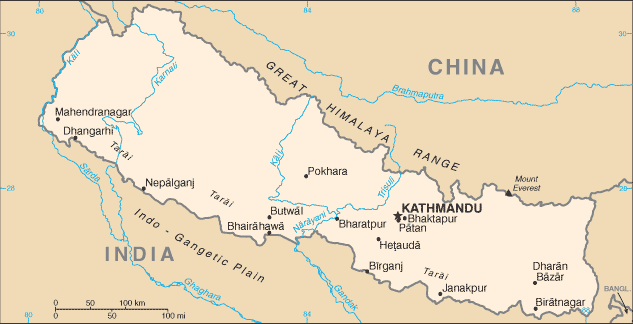
Southern Asia,
between China and India
|
|
Geographic
coordinates: |
28 00 N, 84 00 E
|
|
Map references: |
Asia
|
|
Area: |
total:
140,800 sq km
land: 136,800 sq km
water: 4,000 sq km
|
|
Area -
comparative: |
slightly larger
than Arkansas
|
|
Land boundaries: |
total: 2,926
km
border countries: China 1,236 km, India 1,690 km
|
|
Coastline: |
0 km (landlocked)
|
|
Maritime claims: |
none (landlocked)
|
|
Climate: |
varies from cool
summers and severe winters in north to subtropical summers and
mild winters in south
|
|
Terrain: |
Tarai or flat river
plain of the Ganges in south, central hill region, rugged
Himalayas in north
|
|
Elevation
extremes: |
lowest point:
Kanchan Kalan 70 m
highest point: Mount Everest 8,850 m
|
|
Natural
resources: |
quartz, water,
timber, hydropower, scenic beauty, small deposits of lignite,
copper, cobalt, iron ore
|
|
Land use: |
arable land:
21.68%
permanent crops: 0.64%
other: 77.68% (2001)
|
|
Irrigated land: |
11,350 sq km (1998
est.)
|
|
Natural hazards: |
severe
thunderstorms, flooding, landslides, drought, and famine
depending on the timing, intensity, and duration of the summer
monsoons
|
|
Environment -
current issues: |
deforestation
(overuse of wood for fuel and lack of alternatives);
contaminated water (with human and animal wastes, agricultural
runoff, and industrial effluents); wildlife conservation;
vehicular emissions
|
|
Environment -
international agreements: |
party to:
Biodiversity, Climate Change, Desertification, Endangered
Species, Hazardous Wastes, Law of the Sea, Ozone Layer
Protection, Tropical Timber 83, Tropical Timber 94, Wetlands
signed, but not ratified: Marine Life Conservation
|
|
Geography -
note: |
landlocked;
strategic location between China and India; contains eight of
world's 10 highest peaks, including Mount Everest - the world's
tallest - on the border with China
|
|
People |
|
Population: |
27,676,547 (July
2005 est.)
|
|
Age structure: |
0-14 years:
39% (male 5,575,157/female 5,221,794)
15-64 years: 57.3% (male 8,137,410/female 7,720,691)
65 years and over: 3.7% (male 499,039/female 522,456)
(2005 est.)
|
|
Median age: |
total: 20.07
years
male: 19.91 years
female: 20.24 years (2005 est.)
|
|
Population
growth rate: |
2.2% (2005 est.)
|
|
Birth rate: |
31.45 births/1,000
population (2005 est.)
|
|
Death rate: |
9.47 deaths/1,000
population (2005 est.)
|
|
Net migration
rate: |
0 migrant(s)/1,000
population (2005 est.)
|
|
Sex ratio: |
at birth:
1.05 male(s)/female
under 15 years: 1.07 male(s)/female
15-64 years: 1.05 male(s)/female
65 years and over: 0.96 male(s)/female
total population: 1.06 male(s)/female (2005 est.)
|
|
Infant mortality
rate: |
total: 66.98
deaths/1,000 live births
male: 65.25 deaths/1,000 live births
female: 68.79 deaths/1,000 live births (2005 est.)
|
|
Life expectancy
at birth: |
total
population: 59.8 years
male: 60.09 years
female: 59.5 years (2005 est.)
|
|
Total fertility
rate: |
4.19 children
born/woman (2005 est.)
|
|
HIV/AIDS - adult
prevalence rate: |
0.5% (2001 est.)
|
|
HIV/AIDS -
people living with HIV/AIDS: |
61,000 (2001 est.)
|
|
HIV/AIDS -
deaths: |
3,100 (2003 est.)
|
|
Nationality: |
noun:
Nepalese (singular and plural)
adjective: Nepalese
|
|
Ethnic groups: |
Chhettri 15.5%,
Brahman-Hill 12.5%, Magar 7%, Tharu 6.6%, Tamang 5.5%, Newar
5.4%, Muslim 4.2%, Kami 3.9%, Yadav 3.9%, other 32.7%,
unspecified 2.8% (2001 census)
|
|
Religions: |
Hindu 80.6%,
Buddhist 10.7%, Muslim 4.2%, Kirant 3.6%, other 0.9% (2001
census)
note: only official Hindu state in the world
|
|
Languages: |
Nepali 47.8%,
Maithali 12.1%, Bhojpuri 7.4%, Tharu (Dagaura/Rana) 5.8%, Tamang
5.1%, Newar 3.6%, Magar 3.3%, Awadhi 2.4%, other 10%,
unspecified 2.5% (2001 census)
note: many in government and business also speak English
|
|
Literacy: |
definition:
age 15 and over can read and write
total population: 45.2%
male: 62.7%
female: 27.6% (2003 est.)
|
|
Government |
|
Country name: |
conventional
long form: Kingdom of Nepal
conventional short form: Nepal
|
|
Government type: |
parliamentary
democracy and constitutional monarchy
|
|
Capital: |
Kathmandu
|
|
Administrative
divisions: |
14 zones (anchal,
singular and plural); Bagmati, Bheri, Dhawalagiri, Gandaki,
Janakpur, Karnali, Kosi, Lumbini, Mahakali, Mechi, Narayani,
Rapti, Sagarmatha, Seti
|
|
Independence: |
1768 (unified by
Prithvi Narayan Shah)
|
|
National
holiday: |
Birthday of King
GYANENDRA, 7 July (1946)
|
|
Constitution: |
9 November 1990
|
|
Legal system: |
based on Hindu
legal concepts and English common law; has not accepted
compulsory ICJ jurisdiction
|
|
Suffrage: |
18 years of age;
universal
|
|
Executive
branch: |
chief of state:
King GYANENDRA Bir Bikram Shah (succeeded to the throne 4 June
2001 following the death of his nephew, King DIPENDRA Bir Bikram
Shah)
head of government: Prime Minister Sher Bahadur DEUBA;
note - the Prime Minister resigned in Februrary 2005
cabinet: Cabinet appointed by the monarch on the
recommendation of the prime minister; note - the King dissolved
the Cabinet in February 2005
elections: none; the monarch is hereditary; following
legislative elections, the leader of the majority party or
leader of a majority coalition is usually appointed prime
minister by the monarch
note: King BIRENDRA Bir Bikram Shah Dev died in a bloody
shooting at the royal palace on 1 June 2001 that also claimed
the lives of most of the royal family; King BIRENDRA's son,
Crown Price DIPENDRA, is believed to have been responsible for
the shootings before fatally wounding himself; immediately
following the shootings and while still clinging to life,
DIPENDRA was crowned king; he died three days later and was
succeeded by his uncle
|
|
Legislative
branch: |
: bicameral Parliament consists of the National Council
(60 seats; 35 appointed by the House of Representatives, 10 by
the king, and 15 elected by an electoral college; one-third of
the members elected every two years to serve six-year terms) and
the House of Representatives (205 seats; members elected by
popular vote to serve five-year terms)
elections: House of Representatives - last held 3 and 17
May 1999 (next election NA); note - Nepal's Parliament was
dissolved on 22 May 2002
election results: House of Representatives - percent of
vote by party - NC 37.3%, CPN/UML 31.6%, NDP 10.4%, NSP 3.2%,
Rastriya Jana Morcha 1.4%, Samyukta Janmorcha Nepal 0.8%, NWPP
0.5%, others 14.8%; seats by party - NC 113, CPN/UML 69, NDP 11,
NSP 5, Rastriya Jana Morcha 5, Samyukta Janmorcha Nepal 1, NWPP
1
|
|
Judicial branch: |
Supreme Court or
Sarbochha Adalat (chief justice is appointed by the monarch on
recommendation of the Constitutional Council; the other judges
are appointed by the monarch on the recommendation of the
Judicial Council)
|
|
Political
parties and leaders: |
Communist Party of
Nepal/United Marxist-Leninist or CPN/UML [Madhav Kumar NEPAL,
general secretary]; National Democratic Party or NDP (also
called Rastriya Prajantra Party or RPP) [Surya Bahadur THAPA,
chairman]; People's Front Nepal (Rastriya Jana Morcha) [Chitra
BAHADUR, chairman]; Nepali Congress-Democratic [Sher Bahadur
DEUBA, president]; Nepali Congress or NC [Girija Prasad KOIRALA,
party president; Sushil KOIRALA, general secretary]; Nepal
Sadbhavana (Goodwill) Party or NSP [Bhadri Prasad MANDAL, acting
party president]; Nepal Workers and Peasants Party or NWPP [Narayan
Man BIJUKCHHE, party chairman]; Samyukta Janmorcha Nepal [leader
NA]
|
|
Political
pressure groups and leaders: |
Maoist
guerrilla-based insurgency [Pushpa Kamal DAHAL, also known as
PRAHANDA, chairman; Dr. Baburam BHATTARAI, from Communist Party
of Nepal/Maoist, chief negotiator]; numerous small, left-leaning
student groups in the capital; several small, radical Nepalese
antimonarchist groups
|
|
International
organization participation: |
AsDB, CP, FAO,
G-77, IBRD, ICAO, ICC, ICFTU, ICRM, IDA, IFAD, IFC, IFRCS, ILO,
IMF, IMO, Interpol, IOC, IOM (observer), ISO (correspondent),
ITU, MICAH, MIGA, MONUC, NAM, ONUB, OPCW, SAARC, SACEP, UN,
UNAMSIL, UNCTAD, UNDOF, UNESCO, UNIDO, UNMEE, UNMIK, UNMIL,
UNMISET, UNOCI, UNTSO, UPU, WCO, WFTU, WHO, WIPO, WMO, WTO, WToO,
WTO (observer)
|
|
Flag
description: |
red with a blue
border around the unique shape of two overlapping right
triangles; the smaller, upper triangle bears a white stylized
moon and the larger, lower triangle bears a white 12-pointed sun
|
|
Economy |
|
Economy -
overview: |
Nepal is among the
poorest and least developed countries in the world with 40% of
its population living below the poverty line. Agriculture is the
mainstay of the economy, providing a livelihood for over 80% of
the population and accounting for 40% of GDP. Industrial
activity mainly involves the processing of agricultural produce
including jute, sugarcane, tobacco, and grain. Security concerns
in the wake of the Maoist conflict have led to a decrease in
tourism, a key source of foreign exchange. Nepal has
considerable scope for exploiting its potential in hydropower
and tourism, areas of recent foreign investment interest.
Prospects for foreign trade or investment in other sectors will
remain poor, however, because of the small size of the economy,
its technological backwardness, its remoteness, its landlocked
geographic location, its civil strife, and its susceptibility to
natural disaster.
|
|
GDP: |
purchasing power
parity - $39.53 billion (2004 est.)
|
|
GDP - real
growth rate: |
3% (2004 est.)
|
|
GDP - per
capita: |
purchasing power
parity - $1,500 (2004 est.)
|
|
GDP -
composition by sector: |
agriculture:
40%
industry: 20%
services: 40% (2002 est.)
|
|
Labor force: |
10 million
note: severe lack of skilled labor (1996 est.)
|
|
Labor force - by
occupation: |
agriculture 81%,
industry 3%, services 16%
|
|
Unemployment
rate: |
47% (2001 est.)
|
|
Population below
poverty line: |
42% (1995-96)
|
|
Household income
or consumption by percentage share: |
lowest 10%:
3.2%
highest 10%: 29.8% (1995-96)
|
|
Distribution of
family income - Gini index: |
36.7 (FY95/96)
|
|
Inflation rate
(consumer prices): |
2.9% (2002 est.)
|
|
Budget: |
revenues:
$665 million
expenditures: $1.1 billion, including capital
expenditures of NA (FY99/00 est.)
|
|
Agriculture -
products: |
rice, corn, wheat,
sugarcane, root crops; milk, water buffalo meat
|
|
Industries: |
tourism, carpet,
textile; small rice, jute, sugar, and oilseed mills; cigarette;
cement and brick production
|
|
Industrial
production growth rate: |
8.7% (FY99/00)
|
|
Electricity -
production: |
2.054 billion kWh
(2002)
|
|
Electricity -
production by source: |
fossil fuel:
8.5%
hydro: 91.5%
nuclear: 0%
other: 0% (2001)
|
|
Electricity -
consumption: |
2.005 billion kWh
(2002)
|
|
Electricity -
exports: |
142 million kWh
(2002)
|
|
Electricity -
imports: |
237 million kWh
(2002)
|
|
Oil -
production: |
0 bbl/day (2001
est.)
|
|
Oil -
consumption: |
16,000 bbl/day
(2001 est.)
|
|
Oil - exports: |
NA
|
|
Oil - imports: |
NA
|
|
Exports: |
$568 million
f.o.b., but does not include unrecorded border trade with India
(2002 est.)
|
|
Exports -
commodities: |
carpets, clothing,
leather goods, jute goods, grain
|
|
Exports -
partners: |
India 48.8%, US
22.3%, Germany 8.5% (2004)
|
|
Imports: |
$1.419 billion
f.o.b. (2002 est.)
|
|
Imports -
commodities: |
gold, machinery and
equipment, petroleum products, fertilizer
|
|
Imports -
partners: |
India 43%, UAE 10%,
China 10%, Saudi Arabia 4.4%, Singapore 4% (2004)
|
|
Debt - external: |
$2.7 billion (2001)
|
|
Currency (code): |
Nepalese rupee
(NPR)
|
|
Currency code: |
NPR
|
|
Exchange rates: |
Nepalese rupees per
US dollar - 73.674 (2004), 76.141 (2003), 77.877 (2002), 74.949
(2001), 71.094 (2000)
|
|
Fiscal year: |
16 July - 15 July
|
|
Communications |
|
Telephones -
main lines in use: |
371,800 (2003)
|
|
Telephones -
mobile cellular: |
50,400 (2003)
|
|
Telephone
system: |
general
assessment: poor telephone and telegraph service; fair
radiotelephone communication service and mobile cellular
telephone network
domestic: NA
international: country code - 977; radiotelephone
communications; microwave landline to India; satellite earth
station - 1 Intelsat (Indian Ocean)
|
|
Radio broadcast
stations: |
AM 6, FM 5,
shortwave 1 (January 2000)
|
|
Radios: |
840,000 (1997)
|
|
Television
broadcast stations: |
1 (plus 9
repeaters) (1998)
|
|
Televisions: |
130,000 (1997)
|
|
Internet country
code: |
.np
|
|
Internet hosts: |
917 (2003)
|
|
Internet Service
Providers (ISPs): |
6 (2000)
|
|
Internet users: |
80,000 (2002)
|
|
Transportation |
|
Railways: |
total: 59 km
narrow gauge: 59 km 0.762-m gauge (2004)
|
|
Highways: |
total:
13,223 km
paved: 4,073 km
unpaved: 9,150 km (1999 est.)
|
|
Airports: |
46 (2004 est.)
|
|
Airports - with
paved runways: |
total: 9
over 3,047 m: 1
1,524 to 2,437 m: 1
914 to 1,523 m: 7 (2004 est.)
|
|
Airports - with
unpaved runways: |
total: 37
1,524 to 2,437 m: 1
914 to 1,523 m: 7
under 914 m: 29 (2004 est.)
|
|
Military |
|
Military
branches: |
Royal Nepalese Army
(includes Royal Nepalese Army Air Service), Nepalese Police
Force
|
|
Military
manpower - military age and obligation: |
18 years of age for
voluntary military service (2001)
|
|
Military
manpower - availability: |
males age 18-49:
6,107,091 (2005 est.)
|
|
Military
manpower - fit for military service: |
males age 18-49:
4.193 million (2005 est.)
|
|
Military
manpower - reaching military age annually: |
males:
308,031 (2005 est.)
|
|
Military
expenditures - dollar figure: |
$99.2 million
(2004)
|
|
Military
expenditures - percent of GDP: |
1.5% (2004)
|
|
Transnational Issues |
|
Disputes -
international: |
joint border
commission continues to work on small disputed sections of
boundary with India; India has instituted a stricter border
regime to restrict transit of Maoist insurgents and illegal
cross-border activities
|
|
Refugees and
internally displaced persons:: |
refugees
(country of origin): 104,235 (Bhutan)
IDPs: 100,000-200,000 (ongoing conflict between
government forces and Maoist rebels; displacement spread across
the country) (2004)
|
|
Illicit drugs: |
illicit producer of
cannabis and hashish for the domestic and international drug
markets; transit point for opiates from Southeast Asia to the
West
|

 100+ Important Documents in United States History