|
Introduction |
|
Background: |
Following World War II,
the British withdrew from their mandate of Palestine, and the UN
partitioned the area into Arab and Jewish states, an arrangement
rejected by the Arabs. Subsequently, the Israelis defeated the
Arabs in a series of wars without ending the deep tensions
between the two sides. The territories occupied by Israel since
the 1967 war are not included in the Israel country profile,
unless otherwise noted. On 25 April 1982, Israel withdrew from
the Sinai pursuant to the 1979 Israel-Egypt Peace Treaty. Israel
and Palestinian officials signed on 13 September 1993 a
Declaration of Principles (also known as the "Oslo accords")
guiding an interim period of Palestinian self-rule. Outstanding
territorial and other disputes with Jordan were resolved in the
26 October 1994 Israel-Jordan Treaty of Peace. In addition, on
25 May 2000, Israel withdrew unilaterally from southern Lebanon,
which it had occupied since 1982. In keeping with the framework
established at the Madrid Conference in October 1991, bilateral
negotiations were conducted between Israel and Palestinian
representatives and Syria to achieve a permanent settlement. On
24 June 2002, US President BUSH laid out a "road map" for
resolving the Israeli-Palestinian conflict, which envisions a
two-state solution. However, progress toward a permanent status
agreement has been undermined by Palestinian-Israeli violence
ongoing since September 2000. The conflict may have reached a
turning point with the election in January 2005 of Mahmud ABBAS
as the new Palestinian leader following the November 2004 death
of Yasir ARAFAT.
|
|
Geography |
|
Location: |
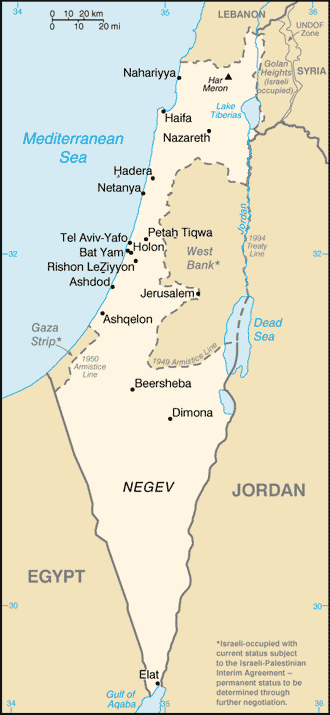
Middle East, bordering the
Mediterranean Sea, between Egypt and Lebanon
|
|
Geographic coordinates: |
31 30 N, 34 45 E
|
|
Map
references: |
Middle East
|
|
Area: |
total: 20,770 sq km
land: 20,330 sq km
water: 440 sq km
|
|
Area -
comparative: |
slightly smaller than New
Jersey
|
|
Land
boundaries: |
total: 1,017 km
border countries: Egypt 266 km, Gaza Strip 51 km, Jordan
238 km, Lebanon 79 km, Syria 76 km, West Bank 307 km
|
|
Coastline: |
273 km
|
|
Maritime claims: |
territorial sea: 12
nm
continental shelf: to depth of exploitation
|
|
Climate: |
temperate; hot and dry in
southern and eastern desert areas
|
|
Terrain: |
Negev desert in the south;
low coastal plain; central mountains; Jordan Rift Valley
|
|
Elevation extremes: |
lowest point: Dead
Sea -408 m
highest point: Har Meron 1,208 m
|
|
Natural
resources: |
timber, potash, copper
ore, natural gas, phosphate rock, magnesium bromide, clays, sand
|
|
Land
use: |
arable land: 16.39%
permanent crops: 4.17%
other: 79.44% (2001)
|
|
Irrigated land: |
1,990 sq km (1998 est.)
|
|
Natural
hazards: |
sandstorms may occur
during spring and summer; droughts; periodic earthquakes
|
|
Environment - current issues: |
limited arable land and
natural fresh water resources pose serious constraints;
desertification; air pollution from industrial and vehicle
emissions; groundwater pollution from industrial and domestic
waste, chemical fertilizers, and pesticides
|
|
Environment - international agreements: |
party to:
Biodiversity, Climate Change, Climate Change-Kyoto Protocol,
Desertification, Endangered Species, Hazardous Wastes, Ozone
Layer Protection, Ship Pollution, Wetlands
signed, but not ratified: Marine Life Conservation
|
|
Geography - note: |
there are 242 Israeli
settlements and civilian land use sites in the West Bank, 42 in
the Israeli-occupied Golan Heights, 25 in the Gaza Strip, and 29
in East Jerusalem (February 2002 est.); Sea of Galilee is an
important freshwater source
|
|
People |
|
Population: |
6,276,883
note: includes about 187,000 Israeli settlers in the West
Bank, about 20,000 in the Israeli-occupied Golan Heights, more
than 5,000 in the Gaza Strip, and fewer than 177,000 in East
Jerusalem (July 2005 est.)
|
|
Age
structure: |
0-14 years: 26.5%
(male 851,415/female 812,095)
15-64 years: 63.7% (male 2,010,888/female 1,986,256)
65 years and over: 9.8% (male 264,708/female 351,521)
(2005 est.)
|
|
Median
age: |
total: 29.39 years
male: 28.58 years
female: 30.27 years (2005 est.)
|
|
Population growth rate: |
1.2% (2005 est.)
|
|
Birth
rate: |
18.21 births/1,000
population (2005 est.)
|
|
Death
rate: |
6.18 deaths/1,000
population (2005 est.)
|
|
Net
migration rate: |
0 migrant(s)/1,000
population (2005 est.)
|
|
Sex
ratio: |
at birth: 1.05
male(s)/female
under 15 years: 1.05 male(s)/female
15-64 years: 1.01 male(s)/female
65 years and over: 0.75 male(s)/female
total population: 0.99 male(s)/female (2005 est.)
|
|
Infant
mortality rate: |
total: 7.03
deaths/1,000 live births
male: 7.77 deaths/1,000 live births
female: 6.26 deaths/1,000 live births (2005 est.)
|
|
Life
expectancy at birth: |
total population:
79.32 years
male: 77.21 years
female: 81.55 years (2005 est.)
|
|
Total
fertility rate: |
2.44 children born/woman
(2005 est.)
|
|
HIV/AIDS - adult prevalence rate: |
0.1% (2001 est.)
|
|
HIV/AIDS - people living with HIV/AIDS: |
3,000 (1999 est.)
|
|
HIV/AIDS - deaths: |
100 (2001 est.)
|
|
Nationality: |
noun: Israeli(s)
adjective: Israeli
|
|
Ethnic
groups: |
Jewish 80.1%
(Europe/America-born 32.1%, Israel-born 20.8%, Africa-born
14.6%, Asia-born 12.6%), non-Jewish 19.9% (mostly Arab) (1996
est.)
|
|
Religions: |
Jewish 76.5%, Muslim
15.9%, Arab Christians 1.7%, other Christian 0.4%, Druze 1.6%,
unspecified 3.9% (2003)
|
|
Languages: |
Hebrew (official), Arabic
used officially for Arab minority, English most commonly used
foreign language
|
|
Literacy: |
definition: age 15
and over can read and write
total population: 95.4%
male: 97.3%
female: 93.6% (2003 est.)
|
|
Government |
|
Country
name: |
conventional long form:
State of Israel
conventional short form: Israel
local long form: Medinat Yisra'el
local short form: Yisra'el
|
|
Government type: |
parliamentary democracy
|
|
Capital: |
Jerusalem; note - Israel
proclaimed Jerusalem as its capital in 1950, but the US, like
nearly all other countries, maintains its Embassy in Tel Aviv
|
|
Administrative divisions: |
6 districts (mehozot,
singular - mehoz); Central, Haifa, Jerusalem, Northern,
Southern, Tel Aviv
|
|
Independence: |
14 May 1948 (from League
of Nations mandate under British administration)
|
|
National holiday: |
Independence Day, 14 May
(1948); note - Israel declared independence on 14 May 1948, but
the Jewish calendar is lunar and the holiday may occur in April
or May
|
|
Constitution: |
no formal constitution;
some of the functions of a constitution are filled by the
Declaration of Establishment (1948), the Basic Laws of the
parliament (Knesset), and the Israeli citizenship law
|
|
Legal
system: |
mixture of English common
law, British Mandate regulations, and, in personal matters,
Jewish, Christian, and Muslim legal systems; in December 1985,
Israel informed the UN Secretariat that it would no longer
accept compulsory ICJ jurisdiction
|
|
Suffrage: |
18 years of age; universal
|
|
Executive branch: |
chief of state:
President Moshe KATZAV (since 31 July 2000)
head of government: Prime Minister Ariel SHARON (since 7
March 2001)
cabinet: Cabinet selected by prime minister and approved
by the Knesset
elections: president is largely a ceremonial role and is
elected by the Knesset for a seven-year term; election last held
31 July 2000 (next to be held mid-2007); following legislative
elections, the president assigns a Knesset member -
traditionally the leader of the largest party - the task of
forming a governing coalition; election last held 28 January
2003 (next scheduled to be held fall of 2006)
election results: Moshe KATZAV elected president by the
120-member Knesset with a total of 60 votes, other candidate,
Shimon PERES, received 57 votes (there were three abstentions);
Ariel SHARON continues as prime minister after Likud Party
victory in January 2003 Knesset elections; Likud won 38 seats
and then formed coalition government with Shinui, the National
Religious Party, and the National Union
|
|
Legislative branch: |
unicameral Knesset (120
seats; members elected by popular vote to serve four-year terms)
elections: last held 28 January 2003 (next scheduled to
be held fall of 2006)
election results: percent of vote by party - Likud Party
29.4%, Labor 14.5%, Shinui 12.3%, Shas 8.2%, National Union
5.5%, Meretz 5.2%, United Torah Judaism 4.3%, National Religious
Party 4.2%, Democratic Front for Peace and Equality 3.0%, One
Nation 2.8%, National Democratic Assembly 2.3%, Yisra'el
Ba'Aliya (YBA) 2.2%, United Arab List 2.1%, Green Leaf Party
1.2%, Herut 1.2%, other 1.6%; seats by party - Likud 38, Labor
19, Shinui 15, Shas 11, National Union 7, Meretz 6, National
Religious Party 6, United Torah Judaism 5, Democratic Front for
Peace and Equality 3, One Nation 3, National Democratic Assembly
3, YBA 2, United Arab List 2
|
|
Judicial branch: |
Supreme Court (justices
appointed for life by the president)
|
|
Political parties and leaders: |
Democratic Front for Peace
and Equality (Hadash) [Muhammad BARAKA]; Green Leaf Party (no
longer active) [Boaz WACHTEL and Shlomi SANDAK]; Herut (no
longer active) [Michael KLEINER]; Labor Party [Shimon PERES];
Likud Party [Ariel SHARON]; Meretz (merged with YAHAD) [Zahava
GALON]; National Democratic Assembly (Balad) [Azmi BISHARA];
National Religious Party [Ephraim "Efie" EITAM]; National Union
(Haichud Haleumi) [Avigdor LIBERMAN] (includes Tekuma Moledet
and Yisra'el Beiteinu); One Nation [David TAL]; Shas [Eliyahu
YISHAI]; Shinui [Yosef "Tommy" LAPID]; United Arab List [Abd al-Malik
DAHAMSHAH]; United Torah Judaism [Yaakov LITZMAN]; YAHAD [Yossi
BEILIN]; Yisra'el Ba'Aliya or YBA (merged with Likud) [Natan
SHARANSKY]
|
|
Political pressure groups and leaders: |
Israeli nationalists
advocating Jewish settlement on the West Bank and Gaza Strip;
Peace Now supports territorial concessions in the West Bank and
Gaza Strip; Yesha (settler) Council promotes settler interests
and opposes territorial compromise; B'Tselem monitors human
rights abuses
|
|
International organization participation: |
BIS, BSEC (observer), CE
(observer), CERN (observer), EBRD, FAO, IADB, IAEA, IBRD, ICAO,
ICC, ICCt (signatory), ICFTU, IDA, IFAD, IFC, IFRCS (observer),
ILO, IMF, IMO, Interpol, IOC, IOM, ISO, ITU, MIGA, OAS
(observer), OPCW (signatory), OSCE (partner), PCA, UN, UNCTAD,
UNESCO, UNHCR, UNIDO, UPU, WCO, WHO, WIPO, WMO, WToO, WTO
|
|
Flag
description: |
white with a blue hexagram
(six-pointed linear star) known as the Magen David (Shield of
David) centered between two equal horizontal blue bands near the
top and bottom edges of the flag
|
|
Economy |
|
Economy
- overview: |
Israel has a
technologically advanced market economy with substantial
government participation. It depends on imports of crude oil,
grains, raw materials, and military equipment. Despite limited
natural resources, Israel has intensively developed its
agricultural and industrial sectors over the past 20 years.
Israel imports substantial quantities of grain, but is largely
self-sufficient in other agricultural products. Cut diamonds,
high-technology equipment, and agricultural products (fruits and
vegetables) are the leading exports. Israel usually posts
sizable current account deficits, which are covered by large
transfer payments from abroad and by foreign loans. Roughly half
of the government's external debt is owed to the US, which is
its major source of economic and military aid. The bitter
Israeli-Palestinian conflict; difficulties in the
high-technology, construction, and tourist sectors; and fiscal
austerity in the face of growing inflation led to small declines
in GDP in 2001 and 2002. The economy grew at 1% in 2003, with
improvements in tourism and foreign direct investment. In 2004,
rising business and consumer confidence - as well as higher
demand for Israeli exports boosted GDP by 3.9%.
|
|
GDP: |
purchasing power parity -
$129 billion (2004 est.)
|
|
GDP -
real growth rate: |
3.9% (2004 est.)
|
|
GDP -
per capita: |
purchasing power parity -
$20,800 (2004 est.)
|
|
GDP -
composition by sector: |
agriculture: 2.8%
industry: 37.7%
services: 59.5% (2003 est.)
|
|
Labor
force: |
2.68 million (2004 est.)
|
|
Labor
force - by occupation: |
agriculture, forestry, and
fishing 2.6%, manufacturing 20.2%, construction 7.5%, commerce
12.8%, transport, storage, and communications 6.2%, finance and
business 13.1%, personal and other services 6.4%, public
services 31.2% (1996)
|
|
Unemployment rate: |
10.7% (2004 est.)
|
|
Population below poverty line: |
18% (2001 est.)
|
|
Household income or consumption by percentage share: |
lowest 10%: 2.4%
highest 10%: 28.3% (1997)
|
|
Distribution of family income - Gini index: |
35.5 (2001)
|
|
Inflation rate (consumer prices): |
0% (2004 est.)
|
|
Investment (gross fixed): |
17.6% of GDP (2004 est.)
|
|
Budget: |
revenues: $48.09
billion
expenditures: $52.11 billion, including capital
expenditures of NA (2004 est.)
|
|
Public
debt: |
104.5% of GDP (2004 est.)
|
|
Agriculture - products: |
citrus, vegetables,
cotton; beef, poultry, dairy products
|
|
Industries: |
high-technology projects
(including aviation, communications, computer-aided design and
manufactures, medical electronics, fiber optics), wood and paper
products, potash and phosphates, food, beverages, and tobacco,
caustic soda, cement, construction, metals products, chemical
products, plastics, diamond cutting, textiles and footwear
|
|
Industrial production growth rate: |
4.5% (2004 est.)
|
|
Electricity - production: |
42.67 billion kWh (2002)
|
|
Electricity - production by source: |
fossil fuel: 99.9%
hydro: 0.1%
nuclear: 0%
other: 0% (2001)
|
|
Electricity - consumption: |
38.3 billion kWh (2002)
|
|
Electricity - exports: |
1.387 billion kWh (2002)
|
|
Electricity - imports: |
0 kWh (2002)
|
|
Oil -
production: |
80 bbl/day (2001 est.)
|
|
Oil -
consumption: |
260,000 bbl/day (2001
est.)
|
|
Oil -
exports: |
NA
|
|
Oil -
imports: |
NA
|
|
Oil -
proved reserves: |
1.92 million bbl (1
January 2002)
|
|
Natural
gas - production: |
10 million cu m (2001
est.)
|
|
Natural
gas - consumption: |
10 million cu m (2001
est.)
|
|
Natural
gas - exports: |
0 cu m (2001 est.)
|
|
Natural
gas - imports: |
0 cu m (2001 est.)
|
|
Natural
gas - proved reserves: |
20.81 billion cu m (1
January 2002)
|
|
Current
account balance: |
$211.9 million (2004 est.)
|
|
Exports: |
$34.41 billion f.o.b.
(2004 est.)
|
|
Exports
- commodities: |
machinery and equipment,
software, cut diamonds, agricultural products, chemicals,
textiles and apparel
|
|
Exports
- partners: |
US 36.8%, Belgium 7.5%,
Hong Kong 4.9% (2004)
|
|
Imports: |
$36.84 billion f.o.b.
(2004 est.)
|
|
Imports
- commodities: |
raw materials, military
equipment, investment goods, rough diamonds, fuels, grain,
consumer goods
|
|
Imports
- partners: |
US 15%, Belgium 10.1%,
Germany 7.5%, Switzerland 6.5%, UK 6.1% (2004)
|
|
Reserves of foreign exchange and gold: |
$28.48 billion (2004 est.)
|
|
Debt -
external: |
$74.46 billion (2004 est.)
|
|
Currency (code): |
new Israeli shekel (ILS);
note - NIS is the currency abbreviation; ILS is the
International Organization for Standarization (ISO) code for the
NIS
|
|
Currency code: |
ILS
|
|
Exchange rates: |
new Israeli shekels per US
dollar - 4.482 (2004), 4.5541 (2003), 4.7378 (2002), 4.2057
(2001), 4.0773 (2000)
|
|
Fiscal
year: |
calendar year
|
|
Communications |
|
Telephones - main lines in use: |
3.006 million (2002)
|
|
Telephones - mobile cellular: |
6.334 million (2002)
|
|
Telephone system: |
general assessment:
most highly developed system in the Middle East although not the
largest
domestic: good system of coaxial cable and microwave
radio relay; all systems are digital
international: country code - 972; 3 submarine cables;
satellite earth stations - 3 Intelsat (2 Atlantic Ocean and 1
Indian Ocean)
|
|
Radio
broadcast stations: |
AM 23, FM 15, shortwave 2
(1998)
|
|
Radios: |
3.07 million (1997)
|
|
Television broadcast stations: |
17 (plus 36 low-power
repeaters) (1995)
|
|
Televisions: |
1.69 million (1997)
|
|
Internet country code: |
.il
|
|
Internet hosts: |
437,516 (2004)
|
|
Internet Service Providers (ISPs): |
21 (2000)
|
|
Internet users: |
2 million (2002)
|
|
Transportation |
|
Railways: |
total: 640 km
standard gauge: 640 km 1.435-m gauge (2004)
|
|
Highways: |
total: 16,903 km
paved: 16,903 km (including 56 km of expressways)
unpaved: 0 km (2002)
|
|
Pipelines: |
gas 140 km; oil 1,509 km
(2004)
|
|
Ports
and harbors: |
Ashdod, Elat (Eilat),
Hadera, Haifa
|
|
Merchant marine: |
total: 17 ships
(1,000 GRT or over) 752,873 GRT/881,711 DWT
by type: cargo 1, container 16
registered in other countries: 48 (2005)
|
|
Airports: |
51 (2004 est.)
|
|
Airports - with paved runways: |
total: 28
over 3,047 m: 2
2,438 to 3,047 m: 4
1,524 to 2,437 m: 8
914 to 1,523 m: 10
under 914 m: 4 (2004 est.)
|
|
Airports - with unpaved runways: |
total: 23
1,524 to 2,437 m: 1
914 to 1,523 m: 2
under 914 m: 20 (2004 est.)
|
|
Heliports: |
3 (2004 est.)
|
|
Military |
|
Military branches: |
Israel Defense Forces (IDF):
Ground Corps, Navy, Air and Space Force (includes Air Defense
Forces); historically there have been no separate Israeli
military services
|
|
Military manpower - military age and obligation: |
17 years of age for
compulsory (Jews, Druzes) and voluntary (Christians, Muslims,
Circassians) military service; both sexes are eligible for
military service; conscript service obligation - 36 months for
men, 21 months for women (2004)
|
|
Military manpower - availability: |
males age 17-49:
1,492,125
females age 17-49: 1,443,916 (2005 est.)
|
|
Military manpower - fit for military service: |
males age 17-49:
1,255,902
females age 17-49: 1,212,394 (2005 est.)
|
|
Military manpower - reaching military age annually: |
males: 53,760
females: 51,293 (2005 est.)
|
|
Military expenditures - dollar figure: |
$9.11 billion (FY03)
|
|
Military expenditures - percent of GDP: |
8.7% (FY02)
|
|
Transnational Issues |
|
Disputes - international: |
West Bank and Gaza Strip
are Israeli-occupied with current status subject to the
Israeli-Palestinian Interim Agreement - permanent status to be
determined through further negotiation; Israel continues
construction of a "seam line" separation barrier along parts of
the Green Line and within the West Bank; Israel announced its
intention to pull out Israeli settlers and withdraw from the
Gaza Strip and four settlements in the northern West Bank in
2005; Golan Heights is Israeli-occupied (Lebanon claims the
Shab'a Farms area of Golan Heights); since 1948, about 350
peacekeepers from the UN Truce Supervision Organization (UNTSO)
headquartered in Jerusalem monitor ceasefires, supervise
armistice agreements, prevent isolated incidents from
escalating, and assist other UN personnel in the region
|
|
Refugees and internally displaced persons:: |
IDPs: 276,000 (Arab
villagers displaced from homes in northern Israel) (2004)
|
|
Illicit
drugs: |
increasingly concerned
about cocaine and heroin abuse; drugs arrive in country from
Lebanon and, increasingly, from Jordan; money-laundering center
|
 100+ Important Documents in United States History