|
Introduction |
|
Background: |
The Maya
civilization flourished in Guatemala and surrounding regions
during the first millennium A.D. After almost three centuries as
a Spanish colony, Guatemala won its independence in 1821. During
the second half of the 20th century, it experienced a variety of
military and civilian governments as well as a 36-year guerrilla
war. In 1996, the government signed a peace agreement formally
ending the conflict, which had left more than 100,000 people
dead and had created some 1 million refugees.
|
|
Geography |
|
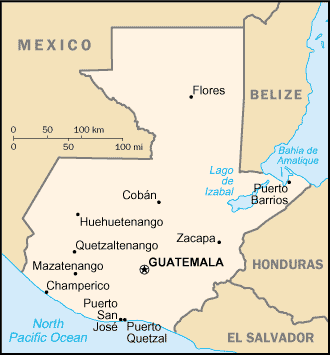
Location: |
Central America,
bordering the North Pacific Ocean, between El Salvador and
Mexico, and bordering the Gulf of Honduras (Caribbean Sea)
between Honduras and Belize
|
|
Geographic
coordinates: |
15 30 N, 90 15 W
|
|
Map references: |
Central America and
the Caribbean
|
|
Area: |
total:
108,890 sq km
land: 108,430 sq km
water: 460 sq km
|
|
Area -
comparative: |
slightly smaller
than Tennessee
|
|
Land boundaries: |
total: 1,687
km
border countries: Belize 266 km, El Salvador 203 km,
Honduras 256 km, Mexico 962 km
|
|
Coastline: |
400 km
|
|
Maritime claims: |
territorial sea:
12 nm
exclusive economic zone: 200 nm
continental shelf: 200-m depth or to the depth of
exploitation
|
|
Climate: |
tropical; hot,
humid in lowlands; cooler in highlands
|
|
Terrain: |
mostly mountains
with narrow coastal plains and rolling limestone plateau (Peten)
|
|
Elevation
extremes: |
lowest point:
Pacific Ocean 0 m
highest point: Volcan Tajumulco 4,211 m
|
|
Natural
resources: |
petroleum, nickel,
rare woods, fish, chicle, hydropower
|
|
Land use: |
arable land:
12.54%
permanent crops: 5.03%
other: 82.43% (2001)
|
|
Irrigated land: |
1,250 sq km (1998
est.)
|
|
Natural hazards: |
numerous volcanoes
in mountains, with occasional violent earthquakes; Caribbean
coast extremely susceptible to hurricanes and other tropical
storms
|
|
Environment -
current issues: |
deforestation in
the Peten rainforest; soil erosion; water pollution
|
|
Environment -
international agreements: |
party to:
Antarctic Treaty, Biodiversity, Climate Change, Climate
Change-Kyoto Protocol, Desertification, Endangered Species,
Environmental Modification, Hazardous Wastes, Law of the Sea,
Marine Dumping, Ozone Layer Protection, Ship Pollution, Wetlands
signed, but not ratified: none of the selected agreements
|
|
Geography -
note: |
no natural harbors
on west coast
|
|
People |
|
Population: |
14,655,189 (July
2005 est.)
|
|
Age structure: |
0-14 years:
42.4% (male 3,185,037/female 3,033,947)
15-64 years: 54.2% (male 4,019,052/female 3,928,984)
65 years and over: 3.3% (male 226,745/female 261,424)
(2005 est.)
|
|
Median age: |
total: 18.47
years
male: 18.25 years
female: 18.71 years (2005 est.)
|
|
Population
growth rate: |
2.57% (2005 est.)
|
|
Birth rate: |
34.11 births/1,000
population (2005 est.)
|
|
Death rate: |
6.81 deaths/1,000
population (2005 est.)
|
|
Net migration
rate: |
-1.63 migrant(s)/1,000
population (2005 est.)
|
|
Sex ratio: |
at birth:
1.05 male(s)/female
under 15 years: 1.05 male(s)/female
15-64 years: 1.02 male(s)/female
65 years and over: 0.87 male(s)/female
total population: 1.03 male(s)/female (2005 est.)
|
|
Infant mortality
rate: |
total: 35.93
deaths/1,000 live births
male: 36.74 deaths/1,000 live births
female: 35.09 deaths/1,000 live births (2005 est.)
|
|
Life expectancy
at birth: |
total
population: 65.14 years
male: 64.27 years
female: 66.04 years (2005 est.)
|
|
Total fertility
rate: |
4.53 children
born/woman (2005 est.)
|
|
HIV/AIDS - adult
prevalence rate: |
1.1% (2003 est.)
|
|
HIV/AIDS -
people living with HIV/AIDS: |
78,000 (2003 est.)
|
|
HIV/AIDS -
deaths: |
5,800 (2003 est.)
|
|
Nationality: |
noun:
Guatemalan(s)
adjective: Guatemalan
|
|
Ethnic groups: |
Mestizo (mixed
Amerindian-Spanish - in local Spanish called Ladino) and
European 59.4%, K'iche 9.1%, Kaqchikel 8.4%, Mam 7.9%, Q'eqchi
6.3%, other Mayan 8.6%, indigenous non-Mayan 0.2%, other 0.1%
(2001 census)
|
|
Religions: |
Roman Catholic,
Protestant, indigenous Mayan beliefs
|
|
Languages: |
Spanish 60%,
Amerindian languages 40% (23 officially recognized Amerindian
languages, including Quiche, Cakchiquel, Kekchi, Mam, Garifuna,
and Xinca)
|
|
Literacy: |
definition:
age 15 and over can read and write
total population: 70.6%
male: 78%
female: 63.3% (2003 est.)
|
|
Government |
|
Country name: |
conventional
long form: Republic of Guatemala
conventional short form: Guatemala
local long form: Republica de Guatemala
local short form: Guatemala
|
|
Government type: |
constitutional
democratic republic
|
|
Capital: |
Guatemala
|
|
Administrative
divisions: |
22 departments (departamentos,
singular - departamento); Alta Verapaz, Baja Verapaz,
Chimaltenango, Chiquimula, El Progreso, Escuintla, Guatemala,
Huehuetenango, Izabal, Jalapa, Jutiapa, Peten, Quetzaltenango,
Quiche, Retalhuleu, Sacatepequez, San Marcos, Santa Rosa, Solola,
Suchitepequez, Totonicapan, Zacapa
|
|
Independence: |
15 September 1821
(from Spain)
|
|
National
holiday: |
Independence Day,
15 September (1821)
|
|
Constitution: |
31 May 1985,
effective 14 January 1986; note - suspended 25 May 1993 by
former President SERRANO; reinstated 5 June 1993 following
ouster of president; amended November 1993
|
|
Legal system: |
civil law system;
judicial review of legislative acts; has not accepted compulsory
ICJ jurisdiction
|
|
Suffrage: |
18 years of age;
universal (active duty members of the armed forces may not vote
and are restricted to their barracks on election day)
|
|
Executive
branch: |
chief of state:
President Oscar Jose Rafael BERGER Perdomo (since 14 January
2004); Vice President Eduardo STEIN Barillas (since 14 January
2004); note - the president is both the chief of state and head
of government
head of government: President Oscar Jose Rafael BERGER
Perdomo (since 14 January 2004); Vice President Eduardo STEIN
Barillas (since 14 January 2004); note - the president is both
the chief of state and head of government
cabinet: Council of Ministers appointed by the president
elections: president elected by popular vote for a
four-year term; election last held 9 November 2003; runoff held
28 December 2003 (next to be held November 2007)
election results: Oscar BERGER Perdomo elected president;
percent of vote - Oscar BERGER Perdomo (GANA) 54.1%, Alvarado
COLOM (UNE) 45.9%
|
|
Legislative
branch: |
unicameral Congress
of the Republic or Congreso de la Republica (158 seats; members
are elected by popular vote to serve four-year terms)
elections: last held 9 November 2003 (next to be held
November 2007)
election results: percent of vote by party - NA%; seats
by party - GANA 49, FRG 41, UNE 33, PAN 17, other 18
note: for the 9 November 2003 election, the number of
congressional seats increased from 113 to 158
|
|
Judicial branch: |
Constitutional
Court or Corte de Constitutcionalidad is Guatemala's highest
court (five judges are elected for concurrent five-year terms by
Congress, each serving one year as president of the
Constitutional Court; one is elected by Congress, one elected by
the Supreme Court of Justice, one appointed by the President,
one elected by Superior Counsel of Universidad San Carlos de
Guatemala, and one by Colegio de Abogados); Supreme Court of
Justice or Corte Suprema de Justicia (13 members serve
concurrent five-year terms and elect a president of the Court
each year from among their number; the president of the Supreme
Court of Justice also supervises trial judges around the
country, who are named to five-year terms)
|
|
Political
parties and leaders: |
Authentic Integral
Development or DIA [Eduardo SUGER]; Democratic Union or UD
[Rodolfo PAIZ Andrade]; Grand National Alliance or GANA [Oscar
BERGER Perdomo]; Green Party or LOV [Rodolfo ROSALES
Garcis-Salaz]; Guatemalan Christian Democracy or DCG [Vinicio
CEREZO Arevalo]; Guatemalan National Revolutionary Unity or URNG
[Alba ESTELA Maldonado, secretary general]; Guatemalan
Republican Front or FRG [Efrain RIOS Montt]; Movement for
Guatemalan Unity or MGU [Jacobo ARBENZ Villanueva]; Movement for
Principals and Values or MPV [Francisco BIANCHI]; National
Advancement Party or PAN [Leonel LOPEZ Rodas, secretary
general]; National Unity for Hope or UNE [Alvarado COLOM
Caballeros]; New Nation Alliance or ANN (formed by an alliance
of DIA, URNG, and several splinter groups most of whom
subsequently defected) [led by three co-equal partners - Nineth
Varenca MONTENEGRO Cottom, Rodolfo BAUER Paiz, and Jorge Antonio
BALSELLS TUT]; Patriot Party or PP [retired General Otto PEREZ
Molina]; Progressive Liberator Party or PLP [Acisclo VALLADARES
Molina]; Reform Movement or MR [Alfredo SKINNER-KLEE, secretary
general]; Unionista Party [leader NA]
|
|
Political
pressure groups and leaders: |
Agrarian Owners
Group or UNAGRO; Alliance Against Impunity or AAI; Committee for
Campesino Unity or CUC; Coordinating Committee of Agricultural,
Commercial, Industrial, and Financial Associations or CACIF;
Mutual Support Group or GAM
|
|
International
organization participation: |
BCIE, CACM, FAO,
G-24, G-77, IADB, IAEA, IBRD, ICAO, ICFTU, ICRM, IDA, IFAD, IFC,
IFRCS, IHO, ILO, IMF, IMO, Interpol, IOC, IOM, ISO
(correspondent), ITU, LAES, LAIA (observer), MIGA, MINUSTAH,
NAM, OAS, ONUB, OPANAL, OPCW, PCA, UN, UNCTAD, UNESCO, UNIDO,
UNOCI, UPU, WCL, WCO, WFTU, WHO, WIPO, WMO, WToO, WTO
|
|
Flag
description: |
three equal
vertical bands of light blue (hoist side), white, and light blue
with the coat of arms centered in the white band; the coat of
arms includes a green and red quetzal (the national bird) and a
scroll bearing the inscription LIBERTAD 15 DE SEPTIEMBRE DE 1821
(the original date of independence from Spain) all superimposed
on a pair of crossed rifles and a pair of crossed swords and
framed by a wreath
|
|
Economy |
|
Economy -
overview: |
Guatemala is the
largest and most populous of the Central American countries with
a GDP per capita roughly one-half that of Brazil, Argentina, and
Chile. The agricultural sector accounts for about one-fourth of
GDP, two-thirds of exports, and half of the labor force. Coffee,
sugar, and bananas are the main products. The 1996 signing of
peace accords, which ended 36 years of civil war, removed a
major obstacle to foreign investment, but widespread political
violence and corruption scandals continue to dampen investor
confidence. The distribution of income remains highly unequal,
with perhaps 75% of the population below the poverty line. Other
ongoing challenges include increasing government revenues,
negotiating further assistance from international donors,
upgrading both government and private financial operations,
curtailing drug trafficking, and narrowing the trade deficit.
|
|
GDP: |
purchasing power
parity - $59.47 billion (2004 est.)
|
|
GDP - real
growth rate: |
2.6% (2004 est.)
|
|
GDP - per
capita: |
purchasing power
parity - $4,200 (2004 est.)
|
|
GDP -
composition by sector: |
agriculture:
22.7%
industry: 19.5%
services: 57.9% (2004 est.)
|
|
Labor force: |
3.68 million (2004
est.)
|
|
Labor force - by
occupation: |
agriculture 50%,
industry 15%, services 35% (1999 est.)
|
|
Unemployment
rate: |
7.5% (2003 est.)
|
|
Population below
poverty line: |
75% (2004 est.)
|
|
Household income
or consumption by percentage share: |
lowest 10%:
1.6%
highest 10%: 46% (1998)
|
|
Distribution of
family income - Gini index: |
55.8 (1998)
|
|
Inflation rate
(consumer prices): |
7.2% (2004 est.)
|
|
Investment
(gross fixed): |
14.9% of GDP (2004
est.)
|
|
Budget: |
revenues:
$2.878 billion
expenditures: $3.411 billion, including capital
expenditures of $750 million (2004 est.)
|
|
Public debt: |
32% of GDP (2004
est.)
|
|
Agriculture -
products: |
sugarcane, corn,
bananas, coffee, beans, cardamom; cattle, sheep, pigs, chickens
|
|
Industries: |
sugar, textiles and
clothing, furniture, chemicals, petroleum, metals, rubber,
tourism
|
|
Industrial
production growth rate: |
4.1% (1999)
|
|
Electricity -
production: |
6.608 billion kWh
(2002)
|
|
Electricity -
production by source: |
fossil fuel:
51.9%
hydro: 35.2%
nuclear: 0%
other: 12.9% (2001)
|
|
Electricity -
consumption: |
5.76 billion kWh
(2002)
|
|
Electricity -
exports: |
440 million kWh
(2002)
|
|
Electricity -
imports: |
55 million kWh
(2002)
|
|
Oil -
production: |
25,000 bbl/day
(2004 est.)
|
|
Oil -
consumption: |
61,000 bbl/day
(2001 est.)
|
|
Oil - exports: |
3,104 bbl/day
(2003)
|
|
Oil - imports: |
NA
|
|
Oil - proved
reserves: |
263 million bbl (1
January 2002)
|
|
Natural gas -
proved reserves: |
1.543 billion cu m
(1 January 2002)
|
|
Current account
balance: |
$-1.381 billion
(2004 est.)
|
|
Exports: |
$2.911 billion
f.o.b. (2004 est.)
|
|
Exports -
commodities: |
coffee, sugar,
petroleum, apparel, bananas, fruits and vegetables, cardamom
|
|
Exports -
partners: |
US 55.6%, El
Salvador 9.7%, Mexico 3.5% (2004)
|
|
Imports: |
$7.77 billion
f.o.b. (2004 est.)
|
|
Imports -
commodities: |
fuels, machinery
and transport equipment, construction materials, grain,
fertilizers, electricity
|
|
Imports -
partners: |
US 33.3%, Mexico
8.5%, South Korea 7.5%, El Salvador 5.2%, China 5%, Venezuela 4%
(2004)
|
|
Reserves of
foreign exchange and gold: |
$3.084 billion
(2004 est.)
|
|
Debt - external: |
$5.969 billion
(2004 est.)
|
|
Currency (code): |
quetzal (GTQ), US
dollar (USD), others allowed
|
|
Currency code: |
GTQ; USD
|
|
Exchange rates: |
quetzales per US
dollar - 7.9465 (2004), 7.9409 (2003), 7.8216 (2002), 7.8586
(2001), 7.7632 (2000)
|
|
Fiscal year: |
calendar year
|
|
Communications |
|
Telephones -
main lines in use: |
846,000 (2002)
|
|
Telephones -
mobile cellular: |
1,577,100 (2002)
|
|
Telephone
system: |
general
assessment: fairly modern network centered in the city of
Guatemala
domestic: NA
international: country code - 502; connected to Central
American Microwave System; satellite earth station - 1 Intelsat
(Atlantic Ocean)
|
|
Radio broadcast
stations: |
AM 130, FM 487,
shortwave 15 (2000)
|
|
Radios: |
835,000 (1997)
|
|
Television
broadcast stations: |
26 (plus 27
repeaters) (1997)
|
|
Televisions: |
1.323 million
(1997)
|
|
Internet country
code: |
.gt
|
|
Internet hosts: |
20,360 (2003)
|
|
Internet Service
Providers (ISPs): |
5 (2000)
|
|
Internet users: |
400,000 (2002)
|
|
Transportation |
|
Railways: |
total: 886
km
narrow gauge: 886 km 0.914-m gauge (2004)
|
|
Highways: |
total:
14,118 km
paved: 4,871 km (including 74 km of expressways)
unpaved: 9,247 km (1999)
|
|
Waterways: |
990 km
note: 260 km navigable year round; additional 730 km
navigable during high-water season (2004)
|
|
Pipelines: |
oil 480 km (2004)
|
|
Ports and
harbors: |
Puerto Quetzal,
Santo Tomas de Castilla
|
|
Airports: |
452 (2004 est.)
|
|
Airports - with
paved runways: |
total: 11
2,438 to 3,047 m: 3
1,524 to 2,437 m: 2
914 to 1,523 m: 4
under 914 m: 2 (2004 est.)
|
|
Airports - with
unpaved runways: |
total: 441
2,438 to 3,047 m: 1
1,524 to 2,437 m: 8
914 to 1,523 m: 109
under 914 m: 323 (2004 est.)
|
|
Military |
|
Military
branches: |
Army, Navy
(includes Marines), Air Force
|
|
Military
manpower - military age and obligation: |
18 years of age for
compulsory and voluntary military service; conscript service
obligation - 30 months (2004)
|
|
Military
manpower - availability: |
males age 18-49:
3,020,292 (2005 est.)
|
|
Military
manpower - fit for military service: |
males age 18-49:
2,106,847 (2005 est.)
|
|
Military
manpower - reaching military age annually: |
males:
161,964 (2005 est.)
|
|
Military
expenditures - dollar figure: |
$201.9 million
(2004)
|
|
Military
expenditures - percent of GDP: |
0.8% (2003)
|
|
Transnational Issues |
|
Disputes -
international: |
Guatemalan
squatters continue to settle in the rain forests of Belize's
border region; OAS is attempting to revive the 2002 failed
Differendum that created a small adjustment to land boundary, a
Guatemalan maritime corridor in Caribbean, a joint ecological
park for the disputed Sapodilla Cays, and a substantial US-UK
financial package; Guatemalans enter Mexico illegally seeking
work or transit to the US
|
|
Refugees and
internally displaced persons:: |
IDPs:
250,000 (government's scorched-earth offensive in 1980s against
indigenous people) (2004)
|
|
Illicit drugs: |
major transit
country for cocaine and heroin; minor producer of illicit opium
poppy and cannabis for mostly domestic consumption; proximity to
Mexico makes Guatemala a major staging area for drugs
(particularly for cocaine); money laundering is a serious
problem; corruption is a major problem; remains on Financial
Action Task Force Non-Cooperative Countries and Territories List
for continued failure to address deficiencies in
money-laundering control regime
|
 100+ Important Documents in United States History